
Phalcoboenus australis

Southern Caracara

Order: Falconiformes / Family: Falconidae / Genus: Phalcoboenus

What is a caracal?

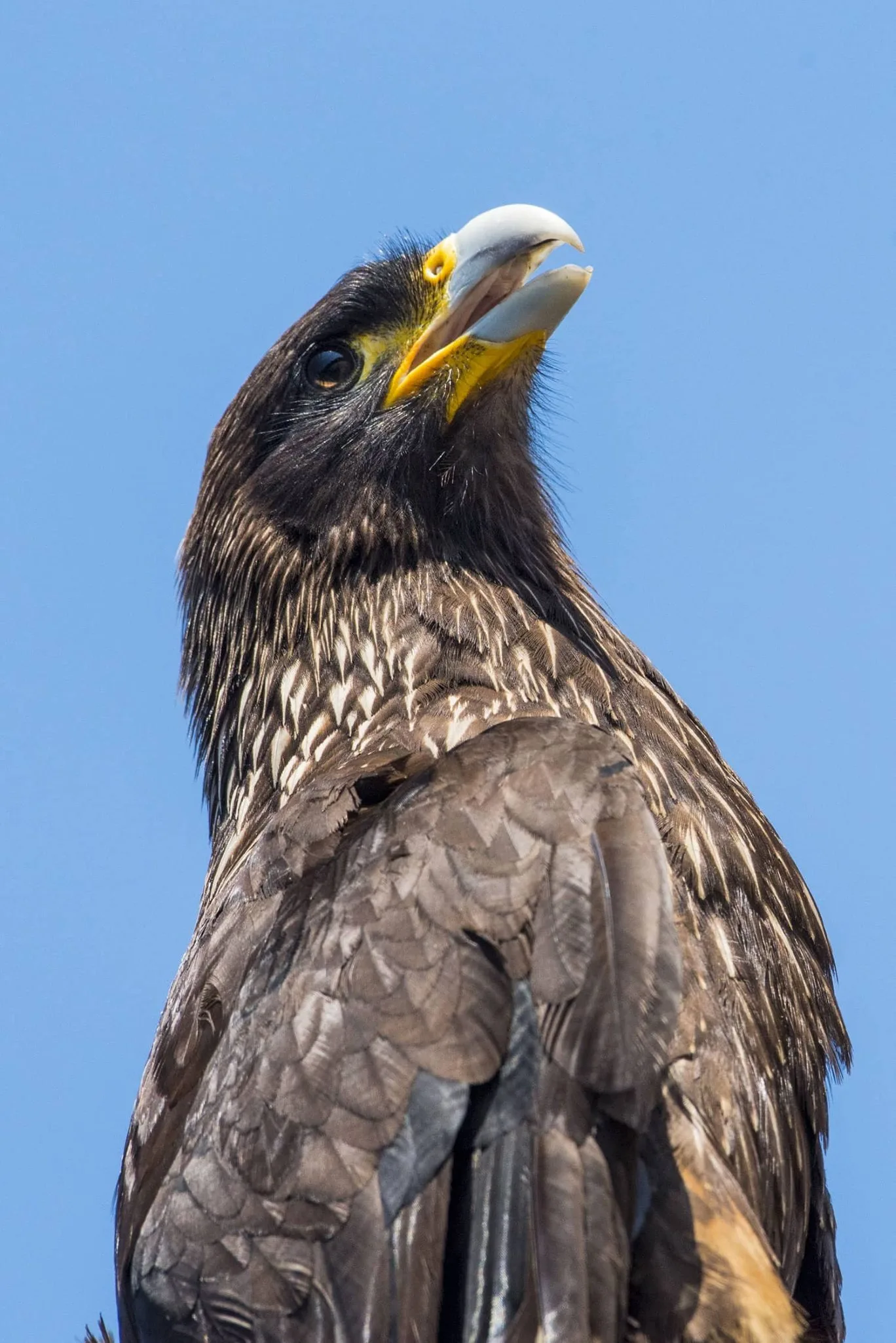
The southern caracara is a bird with dark plumage whose coloration varies from dark brown to black. It has white streaks on the nape and upper back, as well as on the chest. Another distinctive feature is its reddish thighs. A bare patch of yellow skin surrounds the eyes, and the beak is bluish. The underside of the wings is reddish-brown and dotted with white spots. The tail feathers are dark and crossed with a white stripe at the tip. There is no sexual dimorphism for this species.
Juveniles are less dark than adults and have a reddish spot on the upper back as well as on the tail feathers. The adult plumage appears around the age of 5 years.

Weight

1200 grams

Habitat

Prairies and rocky coastal areas

Diet

Carnivore and scavenger

Gestation

30 days

Longevity

25 years

Longevity

12-17 years

Location

Extreme south of Chile and Argentina
Frequently Asked Questions

Where does the caracal live?

The southern caracara resides in the extreme south of Chile and Argentina in the Tierra del Fuego area. It frequents the many islands of Cape Horn. It is also found on the Falkland Islands. These are the birds of prey with the southernmost geographical distribution in the world.
It frequents open plain areas especially along rocky coasts in intertidal zones (the area between low tide and high tide). It can also be found higher up in the low coastal mountains.
Interestingly, they are only found on islands already inhabited by seals and seabirds.

Behavior

The southern caracara has highly developed cognitive abilities. As such, it is naturally curious and does not hesitate to approach humans. It is not uncommon to see it steal objects such as hats or other items from tourists. It seems that red objects are the most prized; one hypothesis is that the color red attracts the bird because it may think it is meat.
According to researchers, this exploratory behavior allows them to find food sources inaccessible to other birds, giving them an advantage. It is quite common to see them turn over stones and small rocks in search of food, for example.
They are social birds that live in groups, especially during hunts where up to 50 individuals can gather. Juveniles form “gangs” to compete with the more aggressive adults. Once they become adults, they have territories that they mark out with powerful calls. This is not a migratory species, despite seasonal movements in the coastal mountains.
Like all other birds of prey, they have exceptional vision, which is said to be eight times better than ours. As a result, they are able to spot food sources from very far away.
They are fast birds that can reach speeds of over 60 km/h.

Reproductive strategy

The breeding season lasts throughout the summer, from December to February. A courtship display involving a head toss is performed by both the female and the male. After that, they build a nest directly on the ground or on cliffs. The nest is made of twigs and the bottom is lined with wool and grass. One can speak of pseudo colonies since, when nesting sites are scarce, nests can be as little as 10 meters apart from each other. The male and female defend the nest against intruders.
The female lays an average of 4 eggs, which are then incubated for about 30 days. The chicks hatch at the same time as the chicks of other species of seabirds in order to benefit from an abundant food source for rearing. The young birds fly away at about 3 months old to form gangs. This increases their chances of survival, especially during their first winter period. The southern caracara can live up to 25-30 years.

What does he eat?

The southern caracara is an opportunistic carnivorous bird that is mostly a scavenger. Its diet consists mainly of penguin or sea lion carcasses. However, they can dig in the ground to find insects or worms. In addition, they may attack weak or injured prey such as seabirds or newborn lambs. They also eat the eggs and chicks of large seabirds such as albatrosses.
Due to its high cognitive ability, the southern caracara is also able to rummage through trash.

Threats and conservation

It is the rarest raptor in the world. The population size is estimated between 1,000 and 2,500 sexually mature individuals for a total of 1,500 to 3,750 individuals. A scientific study showed that the wild population was stable as of 500 pairs. As a result, the species is currently classified as of least concern.
However, due to its curiosity towards humans and its ability to attack newborn lambs, this bird was classified as a pest in 1908. Rewards were given to farmers for each bird killed. As a result, only 17 years later, the caracara had disappeared from the Falkland Islands. It was only in 1930 that the rewards for killing were stopped, and only in 1964 that it was officially protected. Today, it is forbidden to kill a southern caracara without government authorization. It is listed in Appendix II of CITES, which classifies the striated caracara as “not necessarily threatened with extinction, but trade must be controlled in order to avoid use incompatible with their survival”.
Since 1972, the Falkland Islands have been protected and managed as a nature reserve. As a result, caracara populations have recovered on the islands.
Data collection is underway to conduct population monitoring studies, notably thanks to tagging.

Other animals to discover