
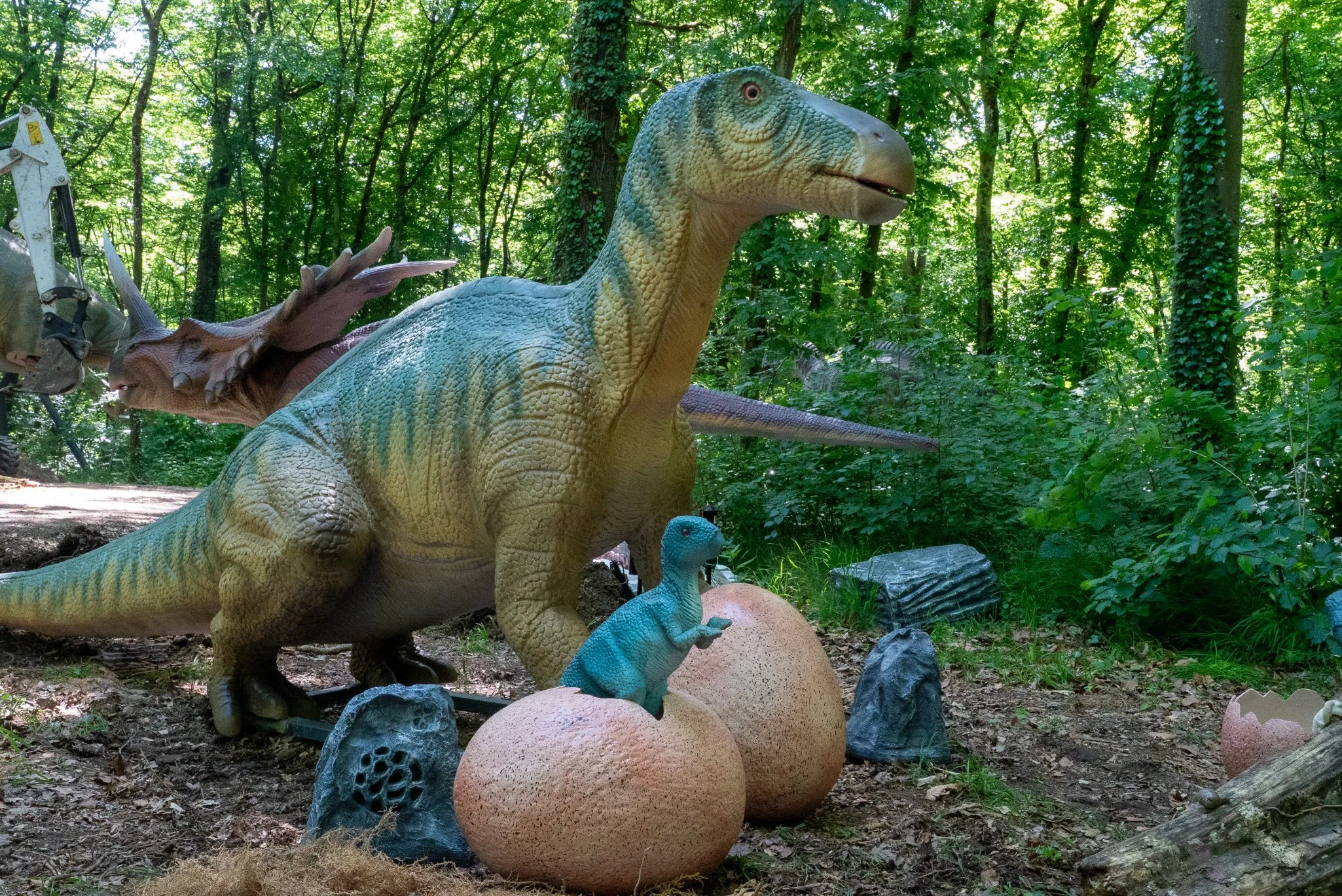

Discovered in 1978, maiasaura means “good mother reptile.” A series of nests were discovered in the same area. The eggs were laid in nests made of twigs and decaying plants to maintain the ideal temperature for development. The female brooded the eggs while the male watched over the area. There could be up to 30 young in a single nest in a single clutch. At birth, they did not exceed 50 cm. The parents cared for the young until they became independent. They pre-chewed the food before giving it to the juveniles, who were unable to walk at birth. The young gained about 3 kilos per day.
Several nests were discovered close to each other, suggesting that adults took turns protecting the eggs and the young.
This dinosaur was gregarious and lived in herds. It is estimated that herds could reach 10,000 individuals. Some scientists think they migrated seasonally to find the amount of food needed for the entire group.
Its long tail allowed it to keep its balance especially when it reared up on two legs to reach food in high places.
Like reptiles and birds, dinosaurs gave birth to their young in eggs. The first fossilized dinosaur eggs were found in the Pyrenees in France in 1859. Although dinosaurs were very large, the eggs measured a maximum of 50 centimeters. The shape, size, and color of the eggs depended on the species.