
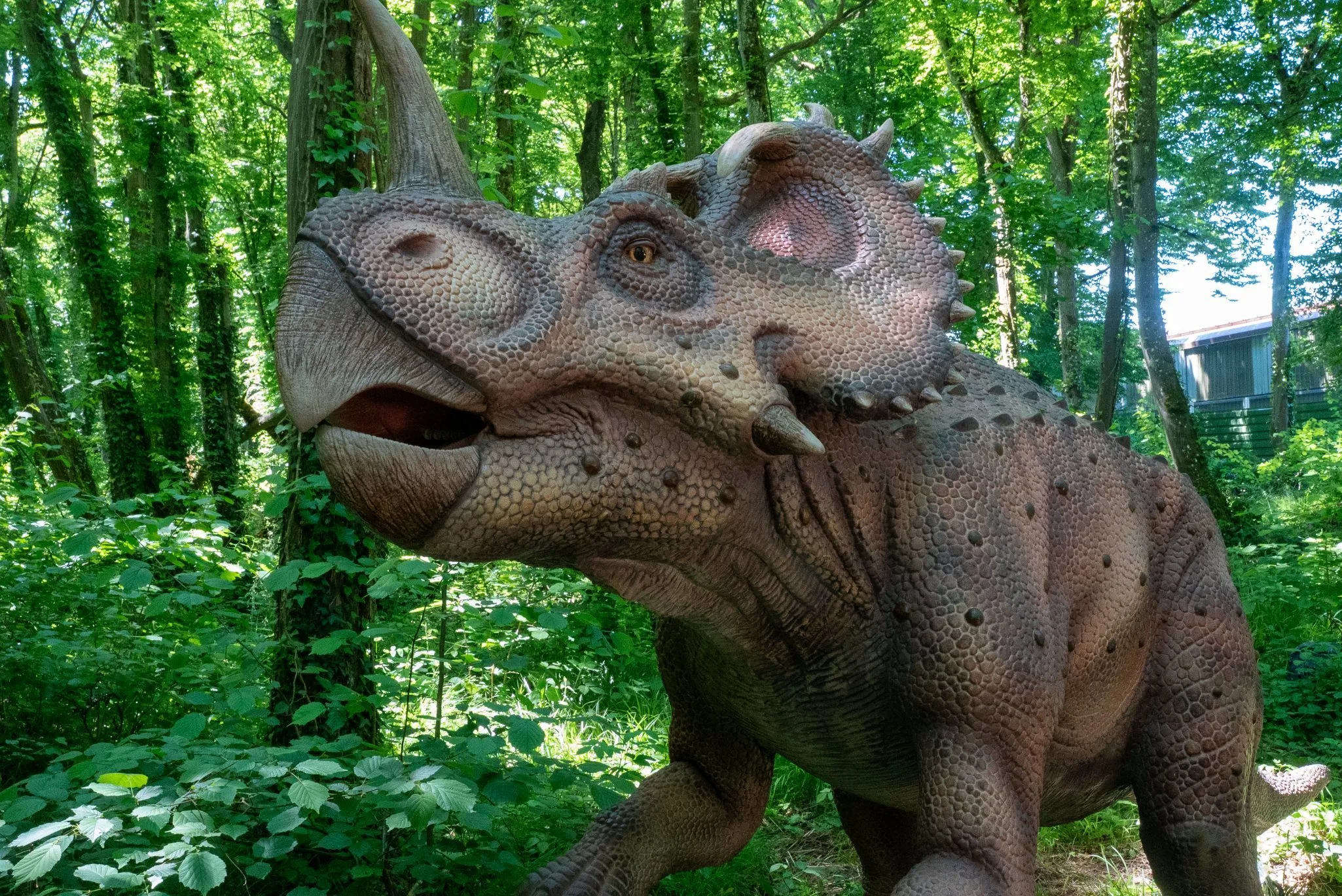

“Spiny lizard”
Much smaller than the triceratops, the centrosaurus had a long horn on its nose and a frill whose edges are adorned with small horns and two longer horns curved forward.
The very particular anatomy of its skull is found in several other Ceratops species. The horns and frills vary in size and shape. This suggests that these ornaments did not always serve to protect them from predators but also had a social function. They can convey messages to impress predators or peers, but also to attract a mate during reproduction.
In the fossils of this species, it was even discovered that the size of the frill gradually became smaller with age, clearly indicating that these ornaments played a role in the sexual maturity and social status of each individual.
Centrosauruses moved and lived in herds of several hundred individuals, which made it easier to protect themselves from predators. The young were then positioned in the center and the males on the edges in order to charge at danger.
The tip of its beak-shaped snout gave it sharp edges for cutting plants, and its teeth at the back of the skull allowed it to grind them.