
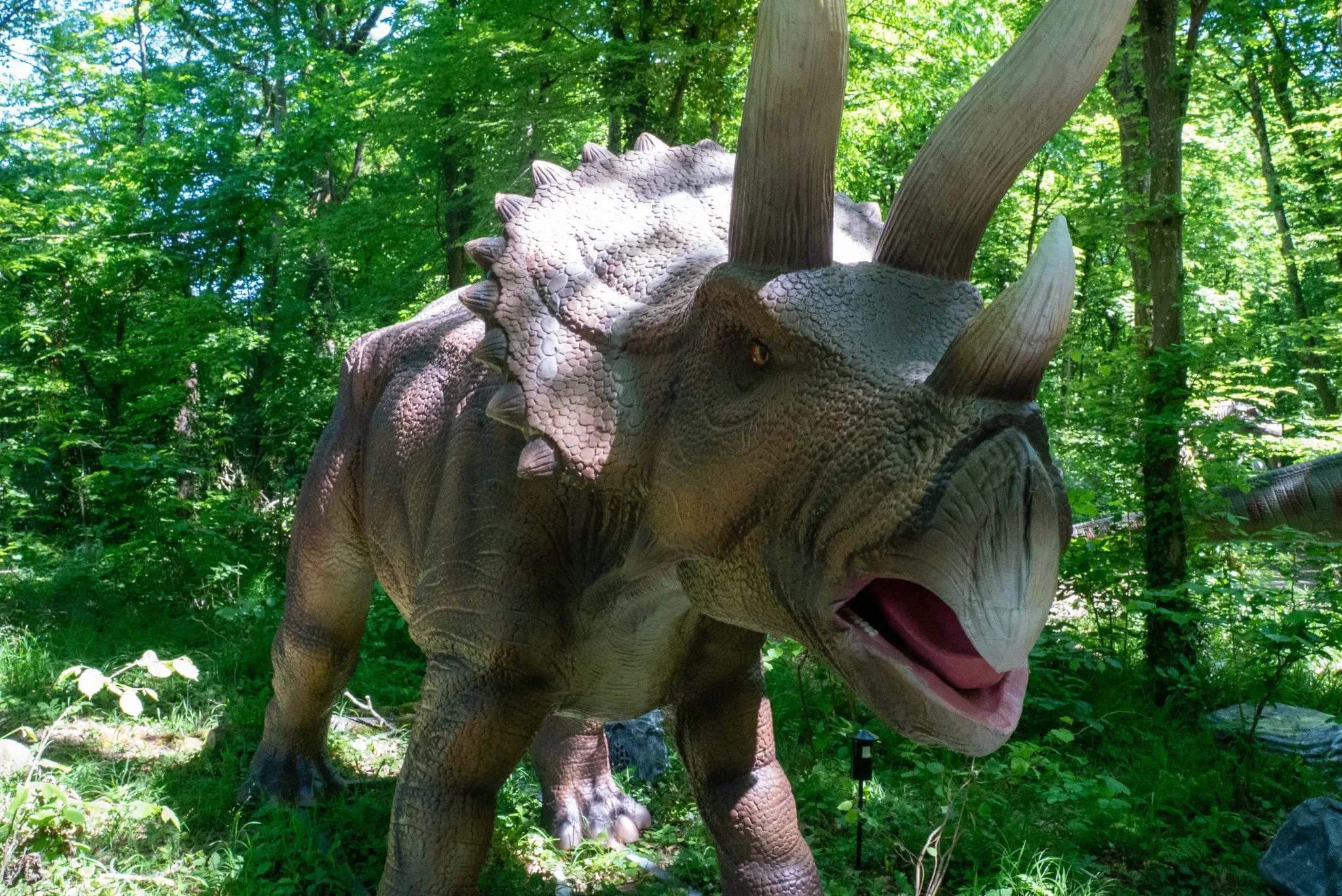

“Face with three horns”
Particularly unusual, the Triceratops is easily recognized by its massive skull adorned with a large frill, 3 horns, and a bird-like beak.
The skull of this dinosaur could reach over 2 meters in length. Its 3 horns, one above the nose and two above the eyes, allowed males to compete with each other to attract females, but also served as defense against predators like the T-rex.
Bite marks from Tyrannosaurus have been found on a severed triceratops horn, indicating that it did not hesitate to challenge these massive herbivores. In the form of scars, its wounds suggest that some triceratops were able to survive the violent attack of the Tyrannosaurus rex.
Indeed, the bony frill at the back of its skull helped protect its neck. But this was apparently not always sufficient because bite marks have been identified on it.
To support such a massive skull, its forelegs, shorter than its hind legs, had large bony crests for the attachment of powerful muscles. The astonishing structure of the first vertebrae just behind the skull gives an idea of the enormous weight of its head. These vertebrae, forming a bony block, strongly stiffen the neck to support this head.
This particular anatomy allowed paleontologists to reconstruct their muscular structure. It also helped to discover that these animals walked on their tiptoes.
The extraordinary shape of its skull is found in several other species of Ceratops. The horns and frills vary in size and shape. This suggests that these ornaments were not always meant to protect them from predators but also had a social function. They can transmit messages to impress predators or peers, but also to attract a mate during reproduction.
The tip of its snout was thin and elongated, its sharp edges were used to cut vegetation, and the teeth at the back of the skull were used to grind it.
A large number of Ceratops fossils were found in groups, showing that they moved and lived in herds, which makes it easier to protect themselves from predators. However, a great majority of Triceratops fossils indicate that this species potentially tended to live in a solitary manner.
Dinosaurs are not known for their intellectual capacity. However, the analysis of a Triceratops skull revealed that this species had a brain that was slightly larger, but above all, more complex in structure! Some dinosaurs may not have been as lacking in cognitive abilities as we think.