Hippopotamus amphibius

Hippopotamus

Order: Cetartiodactyla / Family: Hippopotamidae / Genus: Hippopotamus

What is a hippopotamus?

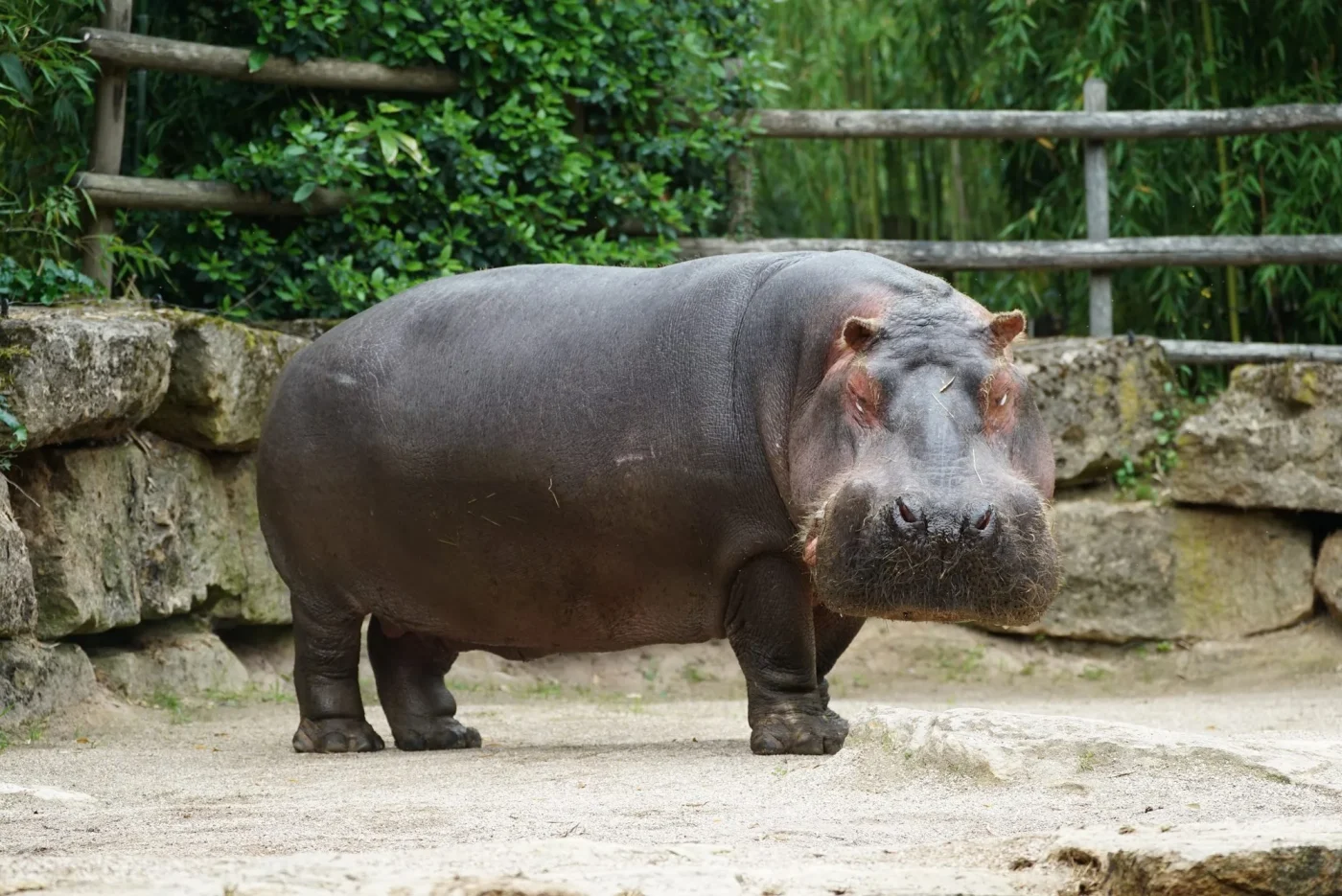
With an average weight between 1,300 and 3,200 kilograms, hippos are among the largest terrestrial mammals in the world. They measure between two and five meters in length, with a shoulder height of 150 to 165 centimeters.

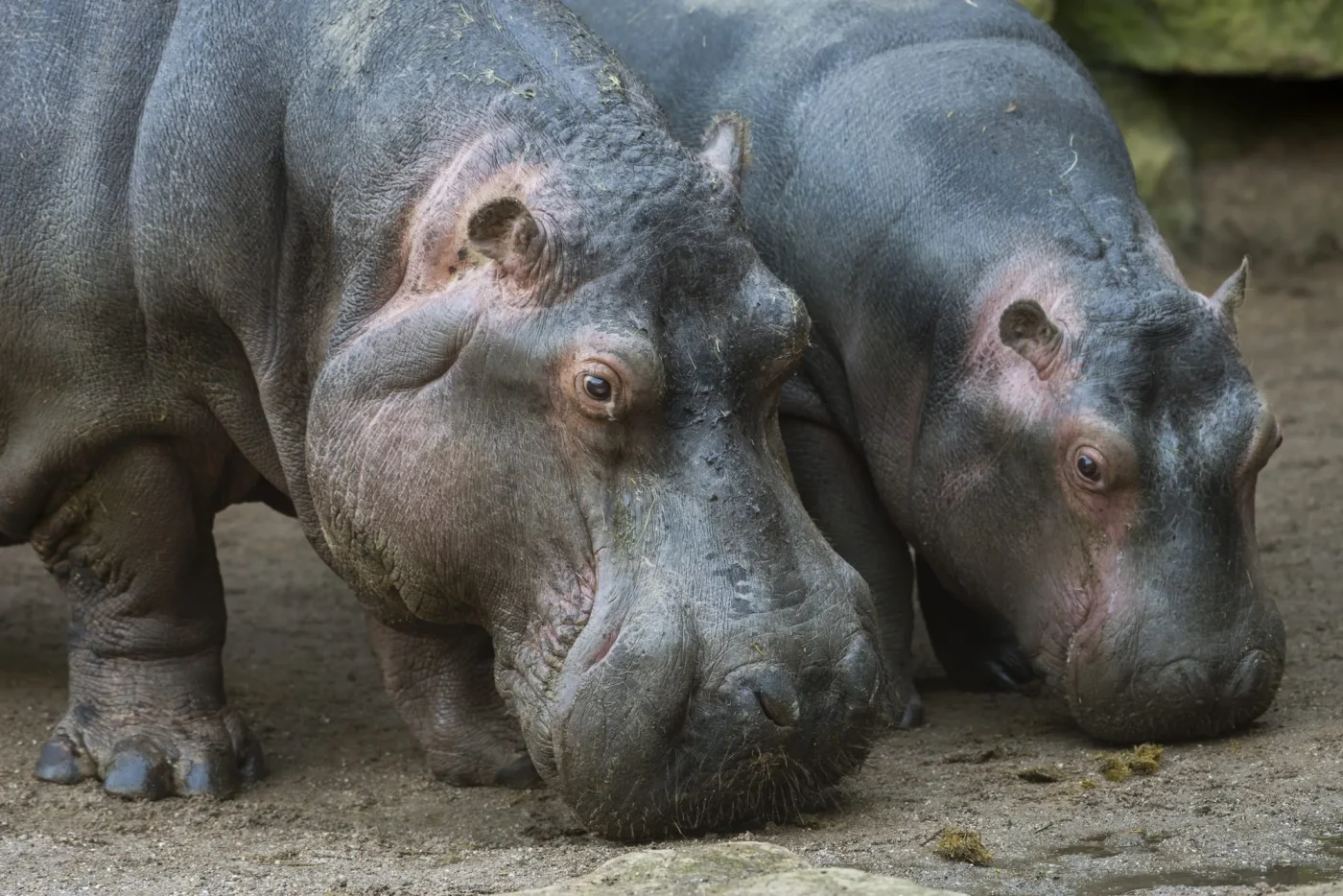
The body is covered with thin skin whose color varies from gray to violet, except for the areas around the eyes, ears, and cheeks, which display a pale pink coloration. There are very few hairs, except on the tip of the tail and the ears. Also, the vibrissae around their mouths help them better navigate underwater when sight is no longer possible.

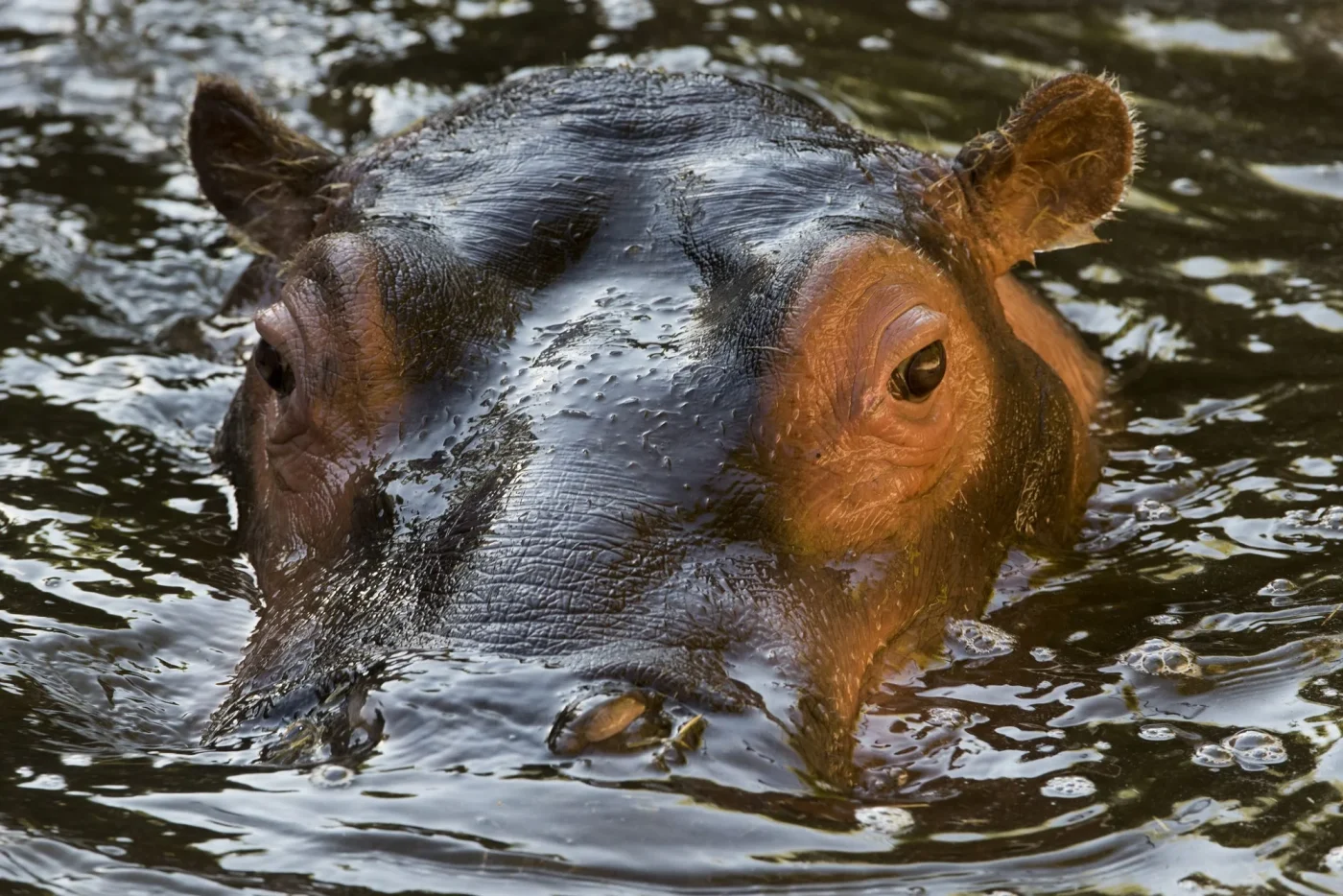
The ears, eyes, and nostrils located at the top of the skull allow them to see and hear what is happening around them while breathing, even when in water.

Not only are they equipped with valves in their ears and nostrils to prevent water from entering their bodies, but they also have a transparent eyelid that allows them to see underwater.

The top layer of their skin, the epidermis, is particularly thin, making them highly sensitive to sunlight. That is why evolution has given these animals mucus glands that produce a colorless oily liquid that turns red after sun exposure. For a long time, it was believed that this was a mixture of sweat and blood, hence its name “blood sweat.” In reality, this substance is made up of hipposudoric acid and norhipposudoric acid, which absorb the sun’s ultraviolet rays. Additionally, it prevents bacterial growth and protects against potential infections.

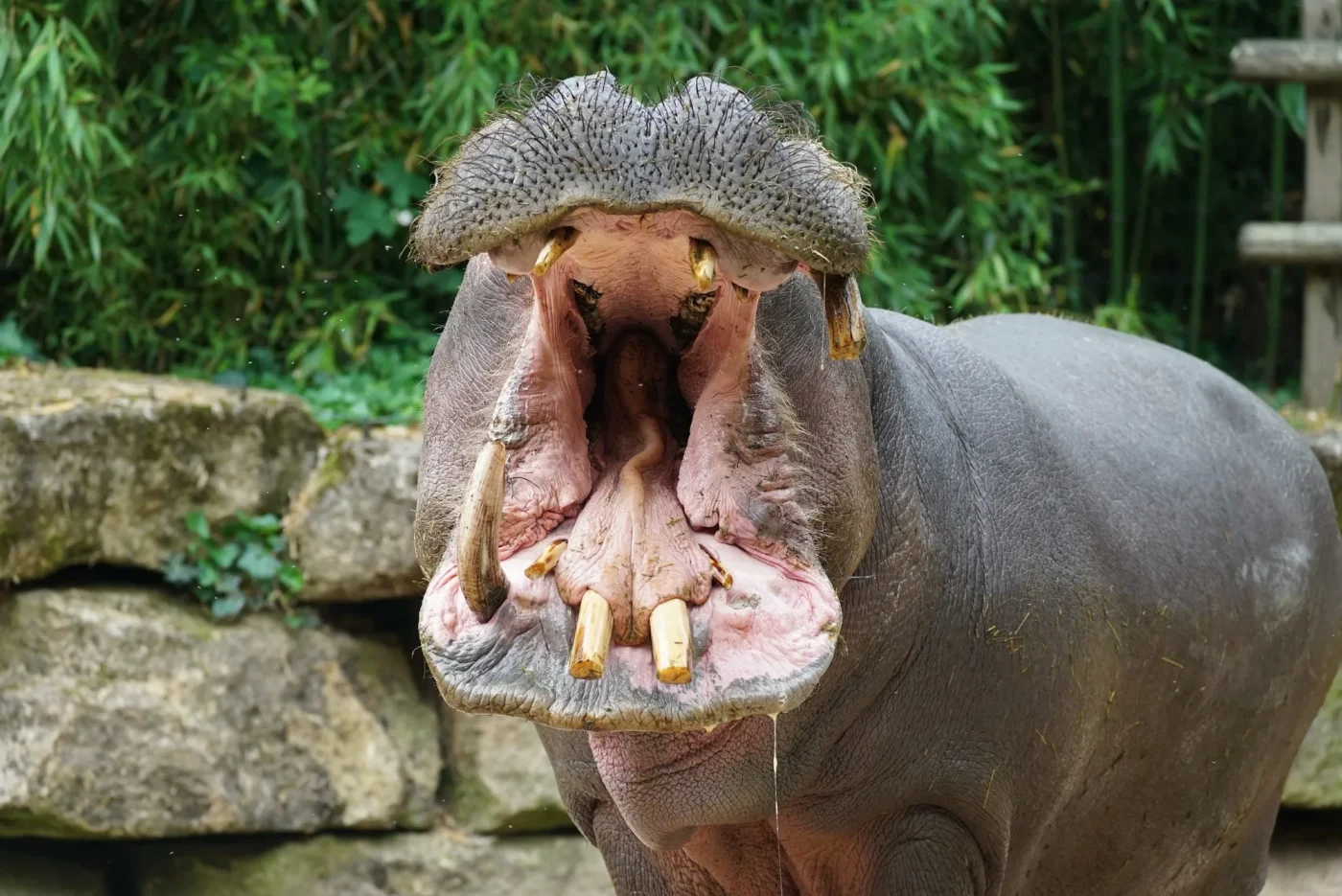
The jaws of hippos are extremely flexible and can open up to nearly 150 degrees. In the mouth are sharpened and highly developed incisors and canines, which can measure 50 and 40 centimeters long, respectively. This is referred to as tusks, just like in elephants.

There is sexual dimorphism because males are more robust than females. It appears that females stop growing while males continue to grow throughout their lives. Females measure on average 3.5 meters long, while males can reach 5 meters. Additionally, the tusks of males are on average twice as long as those of females.

Weight

1,200 – 4,500 kg

Habitat

Savanna, prairie, lake and river

Diet

Herbivore

Gestation

8 - 10 months

Longevity

30 - 40 years

Longevity

12-17 years

Location

Sub-Saharan part of Africa
Frequently Asked Questions

Where does the hippopotamus live?

Hippopotamuses are found in many countries in the sub-Saharan part of Africa. Semi-aquatic, they frequent the waterways of savannas and forests. Thus they are found in rivers, streams, lakes, or swamps as long as there is a minimum depth of two meters to allow complete immersion.

Reproductive strategy

Amphibious hippopotamuses have a polygynous mating system. This means that the male mates with multiple females. In fact, the male has a territory with many females who are part of his harem. There is no real breeding season, but most matings take place during the dry period between February and August. When the male is seeking females, he sniffs the hindquarters of each female to detect if she is in heat. To avoid conflicts, it is the male who submits to the females of the group. Next, as soon as he detects a female in heat, he pushes her with his heavy head to separate her from the group and force her to go towards deeper waters. This is where mating occurs, the male mounts the female and holds her underwater while emitting powerful vocalizations.

Gestation lasts about 8 months, during which the female becomes relatively aggressive towards other individuals. It is during the rainy season, when grass is abundant, that birthing occurs. The female gives birth to a single calf, weighing between 22 and 45 kilograms, in a kind of nest away from the group. It is only two weeks later that she returns to the group with her young. The female encourages her calf to nurse underwater as early as possible, and it will not be weaned before the age of one year. To maximize the survival chances of the young, females adapt their nursing to environmental conditions. If conditions are unfavorable, the young can nurse from several females.

The dominant male of the harem is very protective and does not hesitate to attack intruders to protect his females and young. The mother’s investment allows reproduction only every two years. Sexual maturity occurs during the third year of the young’s life. Hippopotamuses have an average lifespan of 55 years.

What does it eat?

These are strictly herbivorous animals that eat grass, leaves, bark, flowers, or even young shoots.

It is at dusk that hippos leave the water to go in search of food. They look for pastures by moving along various trails present in the territory. On average, they spend 5 hours a night feeding and cover a total of 3 to 4 kilometers. They use their powerful prehensile lips to tear up young shoots, which is why we speak of a mouth rather than a muzzle. Although particularly long at the front, their teeth are not used for feeding but only for fighting. They consume on average 1 to 1.5% of their body weight daily, which is about 40 kilograms per day.

Apart from humans, adult hippos have no predators. However, young hippos can be attacked by lions, hyenas, or crocodiles.

Behavior

The hippopotamus is a social animal that lives in harems; they form groups of 20 to 100 individuals made up of one male and several females with their young. They are extremely territorial animals and therefore extremely dangerous. The males mark the boundaries of the territory with their urine and droppings. They actually have a very particular technique, which, thanks to tail movements, allows them to spread the excrement everywhere.

Despite their size, these are very fast animals that can run at speeds of over 30 kilometers per hour over several hundred meters. Their semi-webbed feet allow them to move efficiently in water. Nevertheless, contrary to popular belief, they don’t really know how to swim. Instead, they move along the bottom of the water.

These are animals that spend the vast majority of their day sleeping in the coolness of the water. The females occupy the center of the group, while the males stay on the periphery. The males fight for dominance during violent combats, during which they vocalize and fight with their jaws and teeth. These fights are violent; the bites cause injuries that can lead to death.

It is only once the sun has set that they become more active and start searching for food. They then leave the water to look for pasture along the shore. They almost always use the same paths and do not stray more than about 2 kilometers from the shore.

The hippopotamus has a wide range of vocalizations whose sounds can reach 115 decibels, which is equivalent to a clap of thunder! In fact, it is one of the only animals capable of vocalizing just as well in the open air as underwater. The sounds made in the air come from the nostrils, while those made underwater originate from the larynx. In reality, it is the fat around the larynx that vibrates and projects the sound into the water.

Threats and Conservation

The distribution and population sizes of the common hippopotamus vary greatly by region. The IUCN reports a decrease of 7 to 20% in the hippo population over the last 10 years, which is an estimated 125,000 to 148,000 individuals. The main causes of this decrease are habitat loss, climate change, agricultural and industrial development, and the diversion of water resources. Additionally, they are poached for their teeth, which, like elephant tusks, are made of ivory. Every year, it is responsible for more than 200 deaths, making it Africa’s deadliest animal. That is why many individuals are killed as a preventive measure.

Anecdote

Following the abandonment of Pablo Escobar’s private zoo in Colombia, the group of hippopotamuses proliferated to reach 130 individuals. Unfortunately, their presence is an environmental threat as they are taking the place of local species like manatees or capybaras.

Life in the park

Here in Amnéville live Mara and Kinshasa, a long-standing couple. Together they have already had 9 young, who have in turn gone on to form couples all over Europe.

Other animals to discover