Giraffa camelopardalis

Giraffe

Order: Cetartiodactyla / Family: Giraffidae / Genus: Giraffa

What is a giraffe?

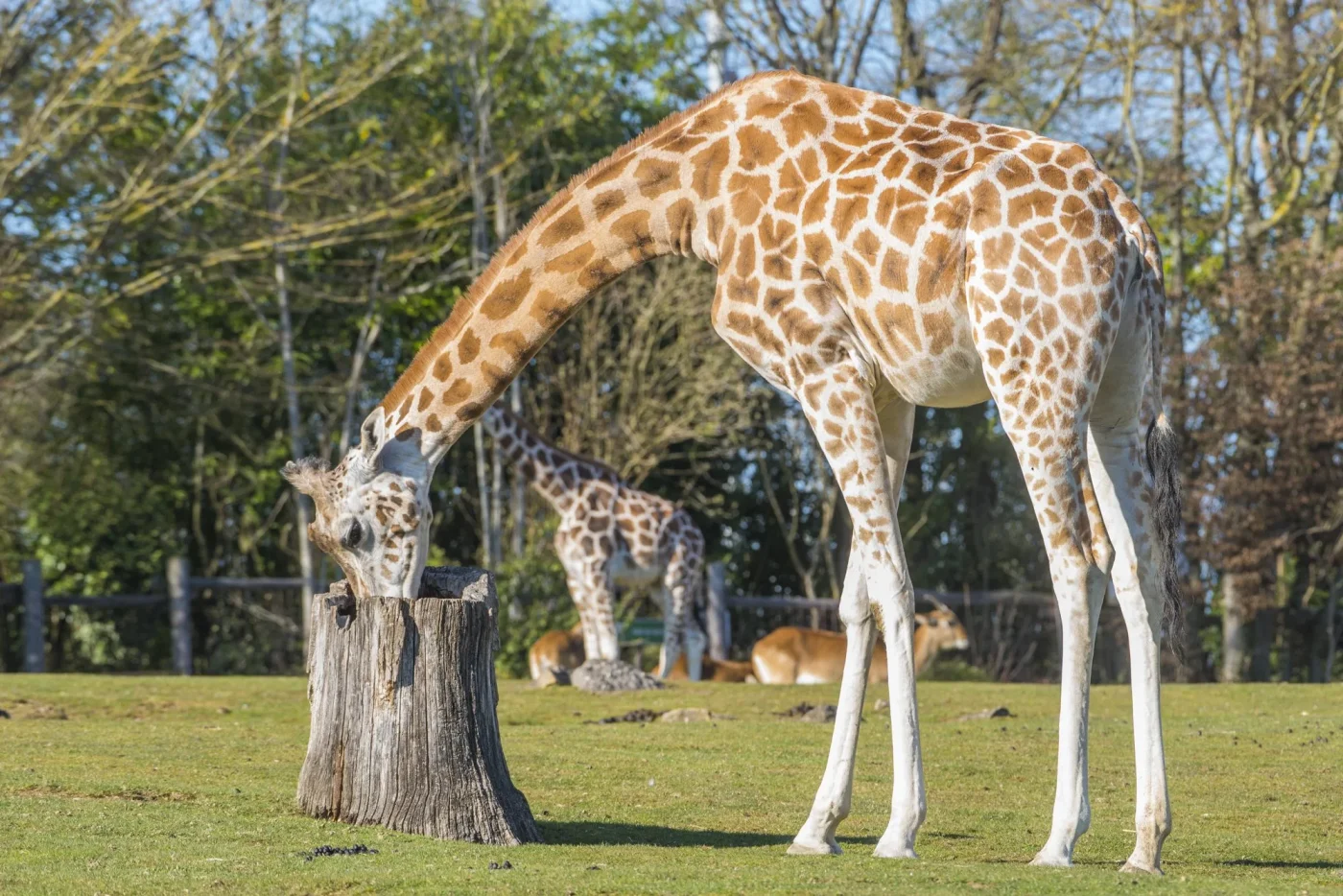
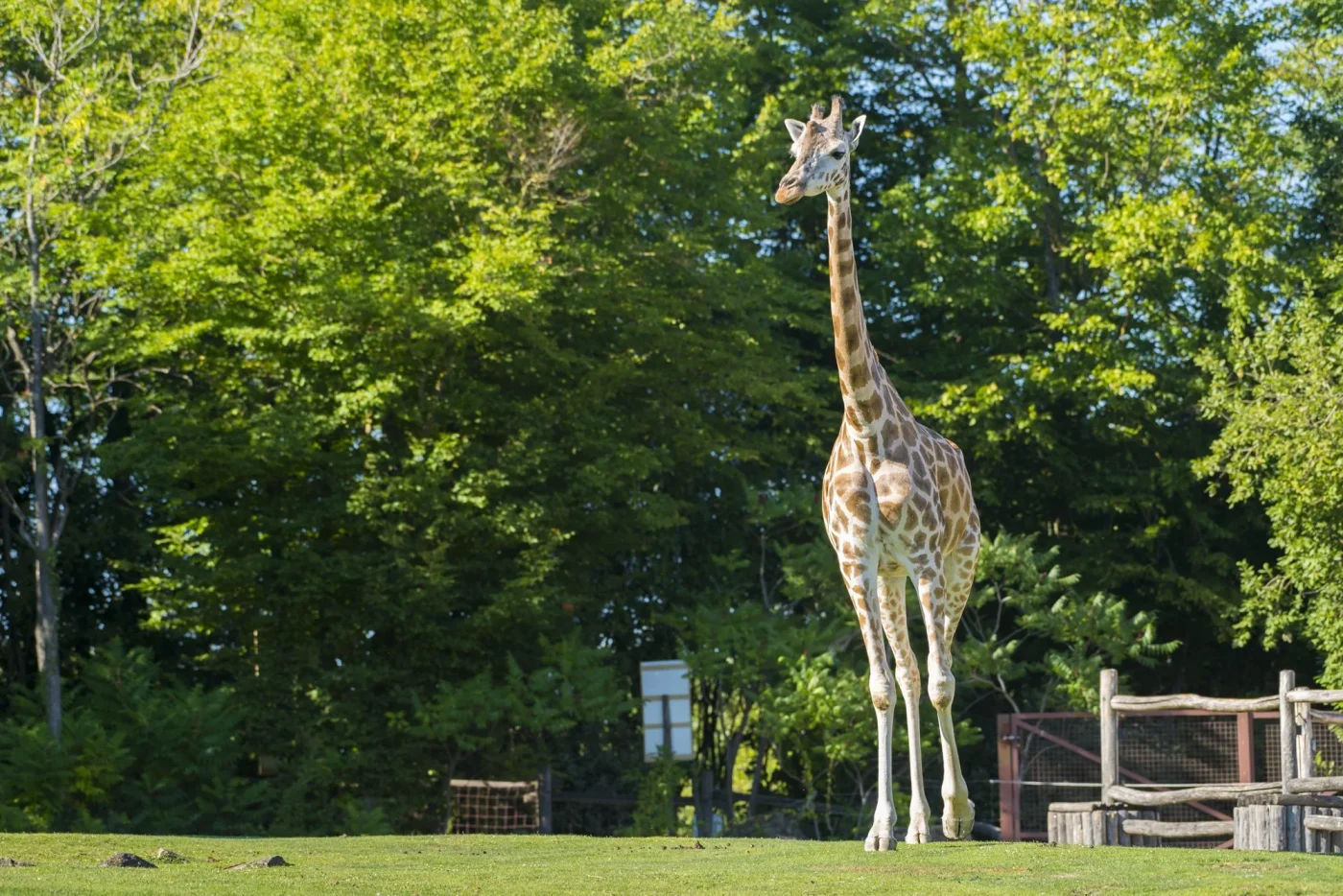
With a height that can reach 6 meters, the giraffe is the tallest terrestrial mammal in the world. Only the males reach these record measurements, since the females, being smaller, almost never exceed 5 meters. The shoulders peak at 3.3 meters tall! The giraffe’s silhouette is unique, possessing four long, slim legs of about 1.80 meters and a long neck of 2.4 meters made up of 7 cervical vertebrae of 30 centimeters each. Thus, males weigh a maximum of only 1,900 kilograms and females 1,180 kilograms.

At birth, the baby giraffe already measures 2 meters tall and weighs 50 kilograms.

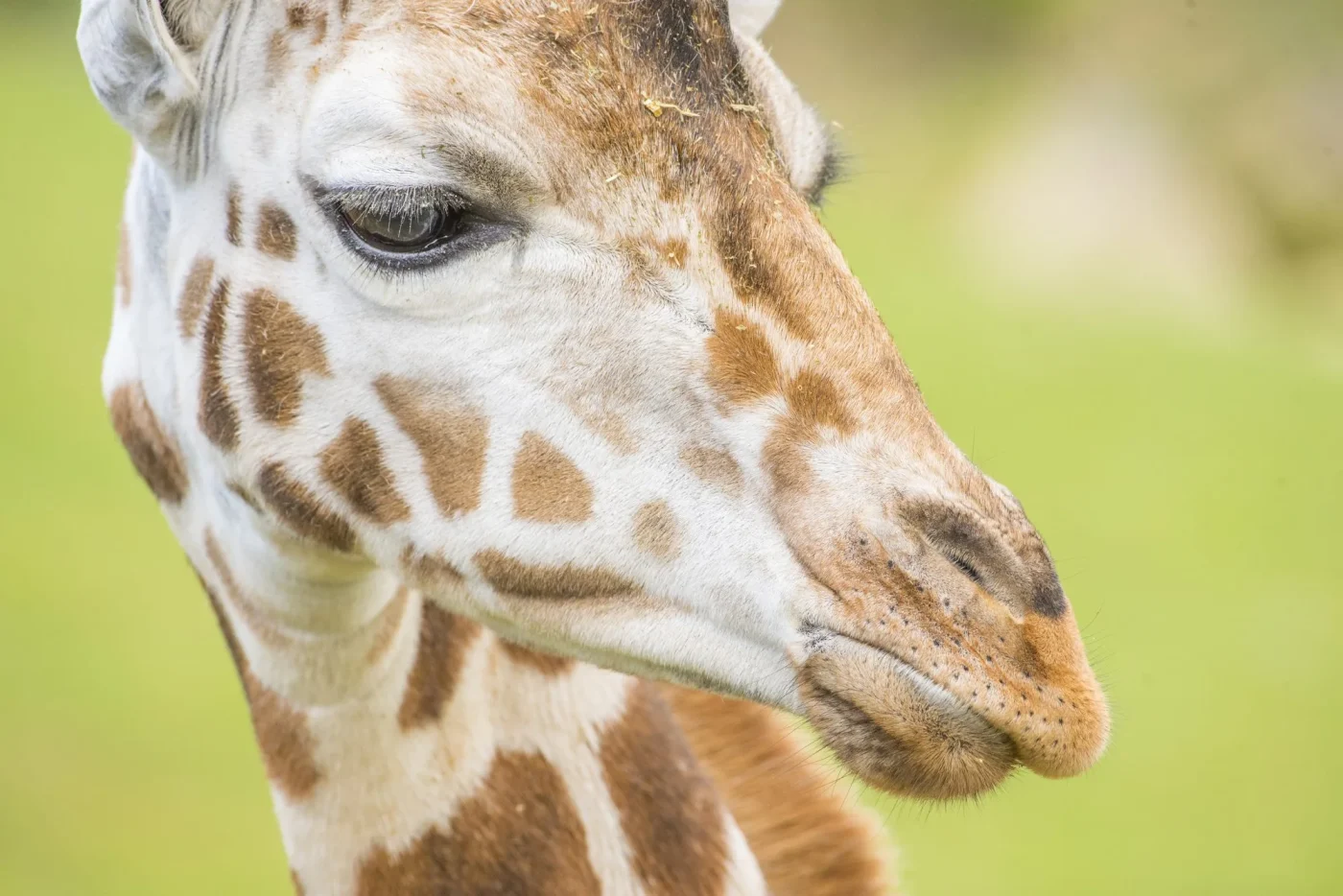
Giraffes have a distinctive spotted coat that is unique to each individual. The coat color ranges from creamy white to orange-yellow, featuring patterns whose colors range from brown-orange to black along the back. These patterns vary among individuals and allow for better camouflage. The belly is generally whitish in color and lacks spots.

Each giraffe species has different spots, which is how we tell them apart. These patterns help regulate body temperature, thanks to the many blood vessels beneath each spot.

The tail is between 75 and 100 centimeters long and ends in a tuft of very thick hair that is used to chase away insects.

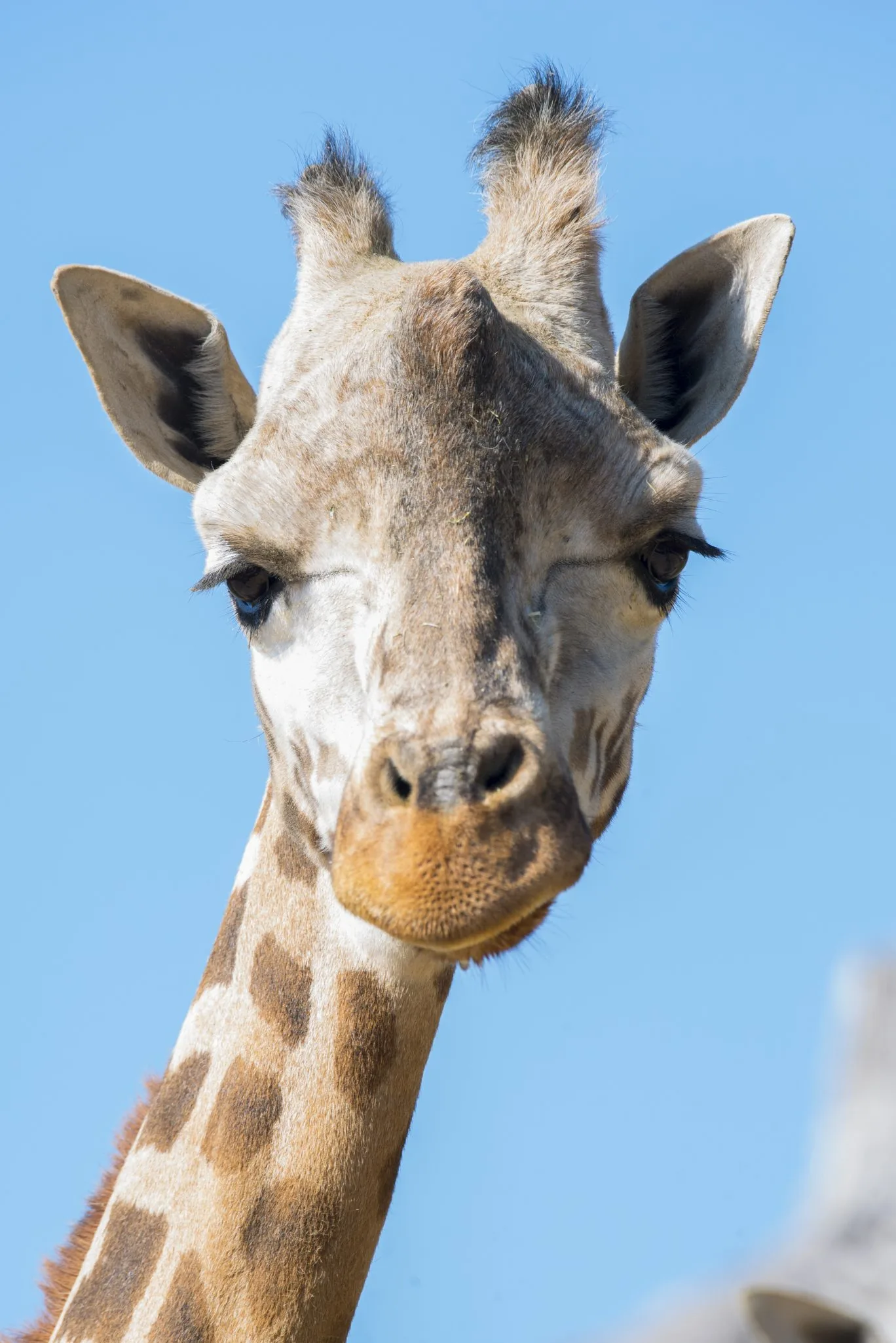
At the top of the massive head are the ossicones, cone-shaped bony structures covered with skin and hair. Both males and females have them, but those of the males are much more developed. Indeed, throughout the life of males, calcium deposits allow the ossicones to grow.

The tongue is blue in color and measures between 45 and 55 centimeters long. It is also the animal that has the largest heart in the animal kingdom in proportion to its weight: it can weigh up to 11 kg. It is thanks to this heart that blood is easily pumped all the way to the head. This big heart pumps 60 liters of blood per minute! In comparison, that of humans only pumps 5 liters per minute.

The lungs of a giraffe contain up to 55 liters of air! In comparison, those of a human contain only 3 or 4 liters.

Where does the giraffe live?

Historically, the giraffe was present throughout most of the African continent. Nowadays, it has disappeared from many regions and only occupies fragmented territories. It is found from Niger in the West to Somalia in the East and down to South Africa.

It lives in many habitats such as dry lands, grasslands, wooded or bushy savannas, as well as open forests south of the Sahara Desert. They mainly seek habitats with Acacias.

Genetic research conducted by the Giraffe Conservation Foundation has shown that there are 4 species of giraffes and 7 subspecies:

  • Masai giraffe (Giraffa tippelskirchi)
    • Luangwa giraffe (G.t. thornicrofti)
    • Masai giraffe (G.t. tippelskirchi)
  • Northern giraffe (Giraffa camelopardalis)
    • Kordofan giraffe (G. c. antiquorum)
    • Nubian giraffe (G. c. camelopardalis)
    • West African giraffe (G. c. peralta)
  • Reticulated giraffe (Giraffa reticulata)
  • Southern giraffe (Giraffa giraffa)


    • Girafe angolaise (G.g. angolensis)

    • Girafe sud-africaine (G.g. giraffa)

Weight

800 - 1,900 kg

Habitat

Savanna and Forest

Diet

Folivore

Gestation

15-16 months

Longevity

10-15 years

Longevity

12-17 years

Location

From Niger in the West to Somalia in the East, and down to South Africa.
Frequently Asked Questions

Where does the giraffe live?

Historically, the giraffe was present throughout most of the African continent. Nowadays, it has disappeared from many regions and only occupies fragmented territories. It can be found from Niger in the West to Somalia in the East and down to South Africa.

It lives in many habitats such as dry lands, grasslands, wooded or bushy savannas, as well as open forests south of the Sahara desert. They mainly seek habitats with Acacias.

Genetic research carried out by the Giraffe Conservation Foundation has shown that there are 4 species of giraffes as well as 7 subspecies:

  • Masai giraffe (Giraffa tippelskirchi)
    • Luangwa giraffe (G.t. thornicrofti)
    • Masai giraffe (G.t. tippelskirchi)
  • Northern giraffe (Giraffa camelopardalis)
    • Kordofan giraffe (G. c. antiquorum)
    • Nubian giraffe (G. c. camelopardalis)
    • East African giraffe (G. c. Peralta)
  • Reticulated giraffe (Giraffa reticulata)
  • Southern giraffe (Giraffa giraffa)
    • Angolan giraffe (G.g. angolensis)
    • South African giraffe (G.g. giraffa)

What does it eat?

The giraffe is a specialist herbivore. It feeds on leaves, flowers, fruits, and tree shoots. Thanks to its long sticky tongue, which can reach up to 50 cm, it can catch the highest leaves of the trees. Its very mobile tongue and lips allow it to easily select leaves on very thorny branches like acacias. Besides, the thorns are ground up by the molars during chewing. The giraffe is a ruminant and can eat up to 66 kilograms of food per day. However, in areas poor in food, it can survive on just 7 kilograms per day.

It can also eat mineral-rich soil.

The giraffe is parasitized by a species of tick that is eaten by oxpecker birds. The giraffe thus provides food to the bird, which in turn frees the giraffe of this parasite. There is therefore a mutually beneficial interaction between the giraffe and the oxpecker birds.

Behavior

Giraffes are social animals that live in loose groups whose size and composition change regularly; this is what we call a fission-fusion system. Groups fluctuate between 10 and 20 individuals, but can gather up to 70 individuals. Individuals are free to move as they wish from one group to another. As a result, groups may be composed of both males and females, only females with or without their young, or only males. It is also not uncommon to see solitary males in the wild. They are not territorial and move according to the availability of food resources.

Males establish a dominance hierarchy for access to females. They start by assessing the strength of their adversary by walking side by side with their necks stretched out horizontally and leaning against their opponent. If neither male submits, they swing their heads pendulum-style toward the neck, flank, or rump of the other male in order to injure them with their ossicones.

The giraffe walks in an ambling gait, meaning it moves both legs on the same side simultaneously. At a run, it can reach speeds of 50–60 km/h (about 31–37 mph).

Giraffes are animals that seem silent, but they can emit whistles or growls in case of danger, for example, to warn the rest of the herd, as well as snoring and moaning sounds. In addition to these vocalizations, they emit infrasound, which is inaudible to humans.

Giraffes are light sleepers; they take micro-naps standing up throughout the day and night, for a total rest time of about 4 hours a day. They may occasionally lie down to rest, but since it takes too long for them to get up at the approach of a predator, this is rare.

Giraffes have very good vision; they are actually considered the sentinels of the savannah. Thanks to their height, they can quickly spot predators. Giraffes can defend themselves by kicking in a 360-degree radius. This method of defense can be deadly, even for a lion.

Reproduction strategy

Giraffes are polygynous, which means that one male can mate with several females, but a female mates with only one male. The breeding period lasts during the rainy season, from September to April. At that time, the male actively seeks a female in estrus by inspecting their urine. He curls his lips in order to analyze the hormones using the Jacobson’s organ, which is located in the palate. If the female is not available for breeding, he moves on. On the other hand, if the female is in oestrus, he rubs his head on her rump and then places it on her back to lick her tail. If the female accepts the male’s advances, she turns around and presents her hindquarters for mating.

Gestation lasts about 15 months, so the young are generally born during the dry season between May and August. Birth takes place standing up, so the newborn experiences a fall from about 2 meters high! Most of the time, there is only one calf at a time, but cases of twins can occur. After just 15 minutes, the calf is already standing and suckling. After the first weeks, the calves are placed in the creche, and the mothers take turns watching over the young giraffes. Without this system, the female would never stray more than 25 meters from her calf. Weaning occurs only around 12 to 16 months old. Females become sexually mature at 3–4 years, while males do not until they are 4–5 years old.

The lifespan ranges between 10 and 15 years in the wild, but can be 20 to 25 years in a zoo.

What are its predators?

Lions are the main predators of giraffes. Leopards and hyenas are also known predators, but this is much rarer. Giraffes are able to defend themselves easily with deadly kicks.

When they drink, they can also fall prey to crocodiles.

Threats and conservation

Although very popular with the general public, giraffes are endangered in the wild. In 30 years, more than 30% of the giraffe population has disappeared. Nowadays, the total number of giraffes on Earth, all species combined, is estimated at only 117,000 individuals. The IUCN estimates the number of mature individuals at only 68,000! They are threatened by the destruction of their habitat, especially due to the expansion of agriculture and the increase in the human population. In addition, poaching for their meat, skin, or the hairs from their tail greatly impacts their populations. This is why the IUCN classifies the giraffe, all species combined, as Vulnerable.

Life at the park

At Amnéville Zoo we welcome Nubian giraffes (G. c. camelopardalis). Our giraffe group is made up of three females including little Gisèle born in September 2020. Gisèle’s parents are Jumani and Liana and the second female is called Kitoja. Here, our giraffes sleep lying down. Their sleep time is closely monitored to ensure the good health of our animals. For example, a night shorter than usual could be a sign of stress.

Other animals to discover