Spheniscus humboldti

Humboldt penguin

Order: Sphenisciformes / Family: Spheniscidae / Genus: Spheniscus

What is a Humboldt penguin?

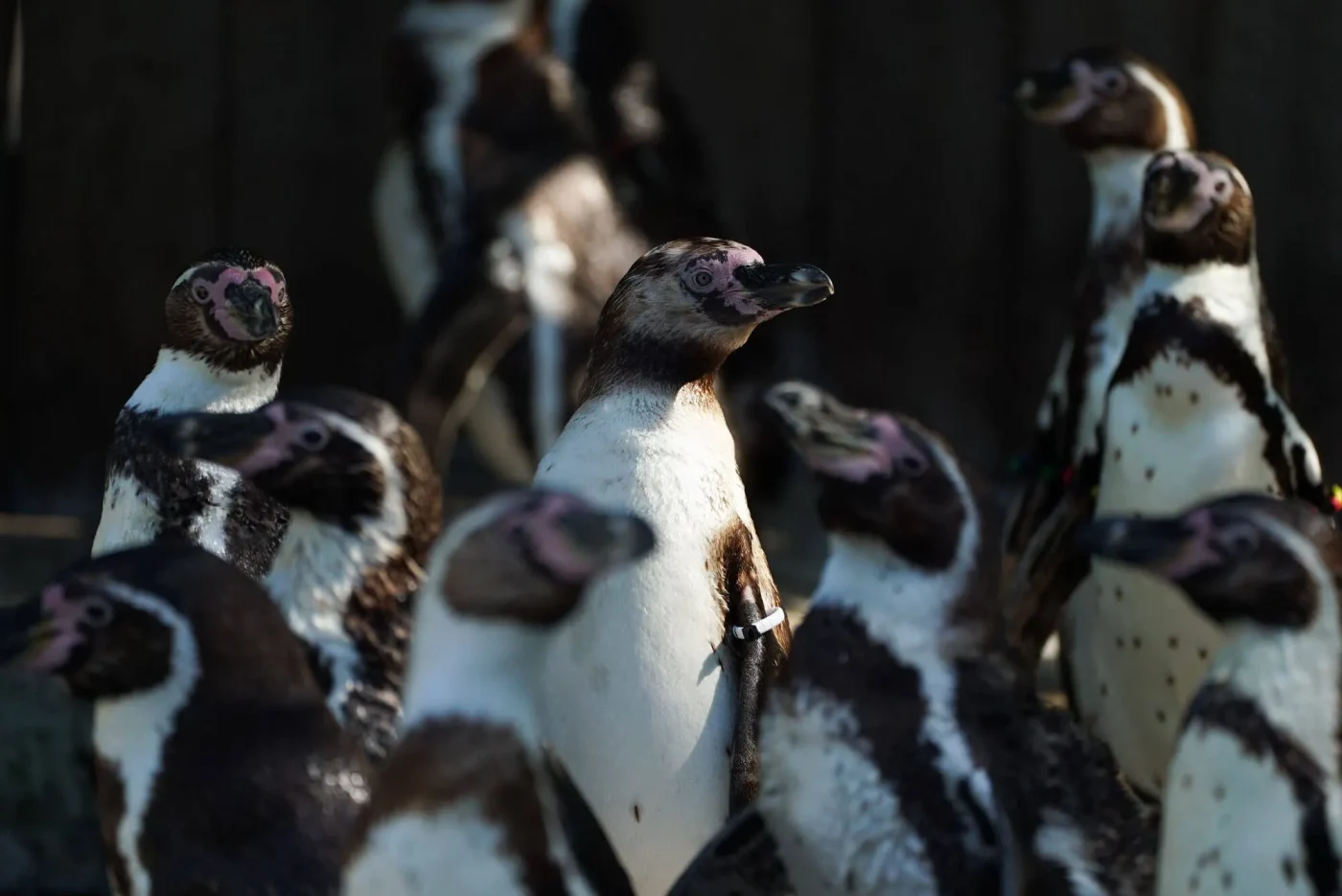
Humboldt penguins are penguins that measure between 66 and 70 cm and can weigh from 4 to 5 kg. They have very dense plumage, white on the belly and black on the back. The particular arrangement of the feathers, which resembles the way tiles are laid on a roof, with one feather partially covering the next, provides waterproof plumage. The head is black and features a thin white line that rises from the neck to above the eye.

It is distinguished from other species by the black, upside-down U-shaped band on its chest as well as the pink skin band connecting the eyes to the beak. This black band on the chest is also used to differentiate juveniles, since only adults have it. Its chest is dotted with black spots, with a pattern unique to each penguin.

The Humboldt penguin is one of the 18 penguin species in the world.

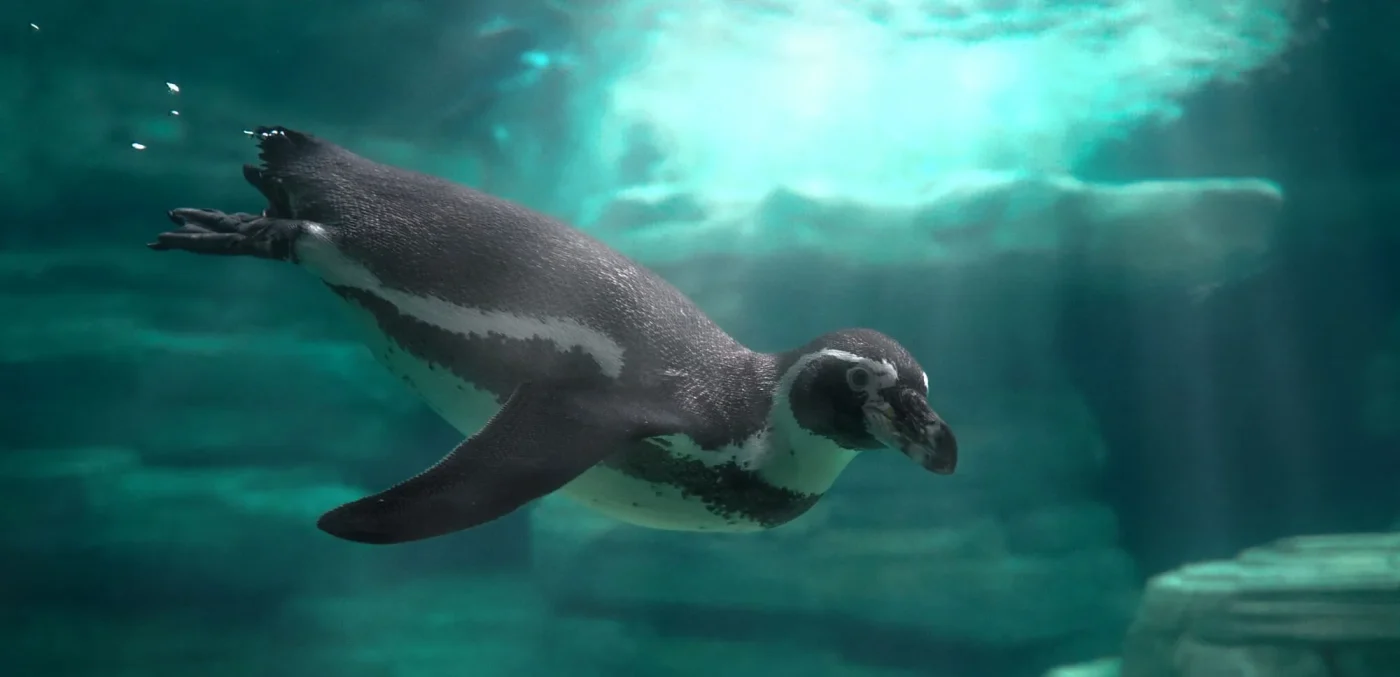
Having lost the ability to fly, this bird has developed remarkable abilities related to the aquatic environment. Its wings have atrophied and turned into flipper-like paddles.

Weight

4-5 kg

Habitat

Coastal marine

Diet

Gestation

40 days

Longevity

15-20 years

Longevity

12-17 years

Location

South America
Frequently Asked Questions

Where does it live?

Humboldt penguins are endemic to the rocky Pacific coasts of Peru and Chile, and they spend most of their time in coastal ocean waters.

What does it eat?

The Humboldt penguin is piscivorous, which means it feeds mainly on pelagic fish such as anchovies, herrings, and sardines, but it can also catch some crustaceans and small cephalopods like squid. It is a very enduring bird that can sometimes spend more than 60 hours at sea in search of food before coming back ashore to rest. Penguins raising chicks mostly fish during the day and dive less deep and for shorter periods than those not raising chicks.

Behavior

Penguins are birds that have lost their ability to fly in favor of swimming. Thanks to their strong swimming flippers, they can swim at 30 km/h and dive to a depth of 60 m. They can hold their breath for almost 15 minutes.

Their very dense plumage, a true diving suit, is kept waterproof due to an oily secretion produced by a gland at the base of the rump, with which they regularly coat their feathers using their beak. This plumage is renewed once a year in about two weeks in the summer; this is called molting. During molting, all the damaged feathers from the previous year fall out and new ones appear. As a result, having no feathers to insulate from the water, the penguins do not go back in the water when young.

Humboldt penguins are social and live in large groups called colonies in which penguins live in pairs. Each penguin has unique vocal sounds, which allows partners to recognize each other.

A penguin’s vision is just as good in water as it is out of water. Penguins also have a well-developed sense of smell, allowing them to recognize familiar scents. This may allow them to recognize partners and colony members. Furthermore, it may also allow penguins to recognize related individuals to avoid inbreeding.

What are its predators?

In its natural environment, the Humboldt penguin has many predators both at sea and on land. They are hunted by sea lions, sharks, as well as by foxes, wild cats, snakes, rodents, or gulls that attack the chicks and eggs.

Nevertheless, penguins possess defensive tactics against predators, such as their black and white coloring that allows them to blend in with the depth of the ocean or the brightness of the sun. On land, their large numbers can sometimes scare off the least courageous predators.

Reproduction strategy

Humboldt penguins are monogamous and therefore have only one partner in their lifetime. However, in rare cases the female may seek out another male for reproduction. The warm climate of their habitat allows breeding from March to December. The nest is dug and shaped in the droppings of seabirds accumulated on the ground, called guano. In this burrow, the female will then lay 2 eggs that will be incubated and raised by both parents. The young stay in the nest for another 3 months until their down is replaced by feathers, allowing them to go to sea to feed on their own.

Reproduction is greatly negatively impacted by human presence during tourist visits.

What threatens it?

The Humboldt penguin is one of the most endangered penguin species. Industrial fishing, targeting the same prey as them, considerably reduces their food source. Moreover, some individuals get trapped in fishermen’s nets. The introduction of predators that were absent from these regions of the world, as well as tourism, also threatens the penguins. But it is especially the exploitation of guano that has reduced and degraded the quality of the penguins’ nesting sites. Considered an excellent fertilizer by humans, it is extracted exponentially from these coasts, resulting in a reduction of reproduction; it is a major source of revenue for the Peruvian government. The Humboldt penguins are also affected by the natural phenomenon called “El Niño.” It is a phenomenon of marine current that moves warm water from Australia to South America, causing a disruption of the cold Humboldt Current. This disturbance prevents the cold deep waters and nutrients from rising near the coasts of Peru and Chile. As a result, the availability of fish is much lower for the penguins and their survival is impacted.

Anecdotes

The Pacific coasts of South America are bordered by the Humboldt Current, named in honor of explorer Alexander Von Humboldt.

The penguin is very often confused with the auk, and this confusion is due to the fact that in many languages, such as English, the word “manchot” is translated as “penguin”—which actually means auk. Even though these two species resemble each other in their coloration, they are actually two distinct species. The auk is a bird capable of flight and lives only in the northern hemisphere of our planet. On the other hand, all penguin species are incapable of flight and inhabit only the southern hemisphere!

Discover other animal species from the Americas: lowland tapir, emperor tamarin, cotton-top tamarin, Patagonian sea lion, California sea lion, maned wolf, giant anteater, golden eagle, hyacinth macaw, raccoon, red coati, puma, wolverine, jaguar, snowy owl, squirrel monkey, Humboldt penguin, military macaw, Humboldt penguin.

Other animals to discover