
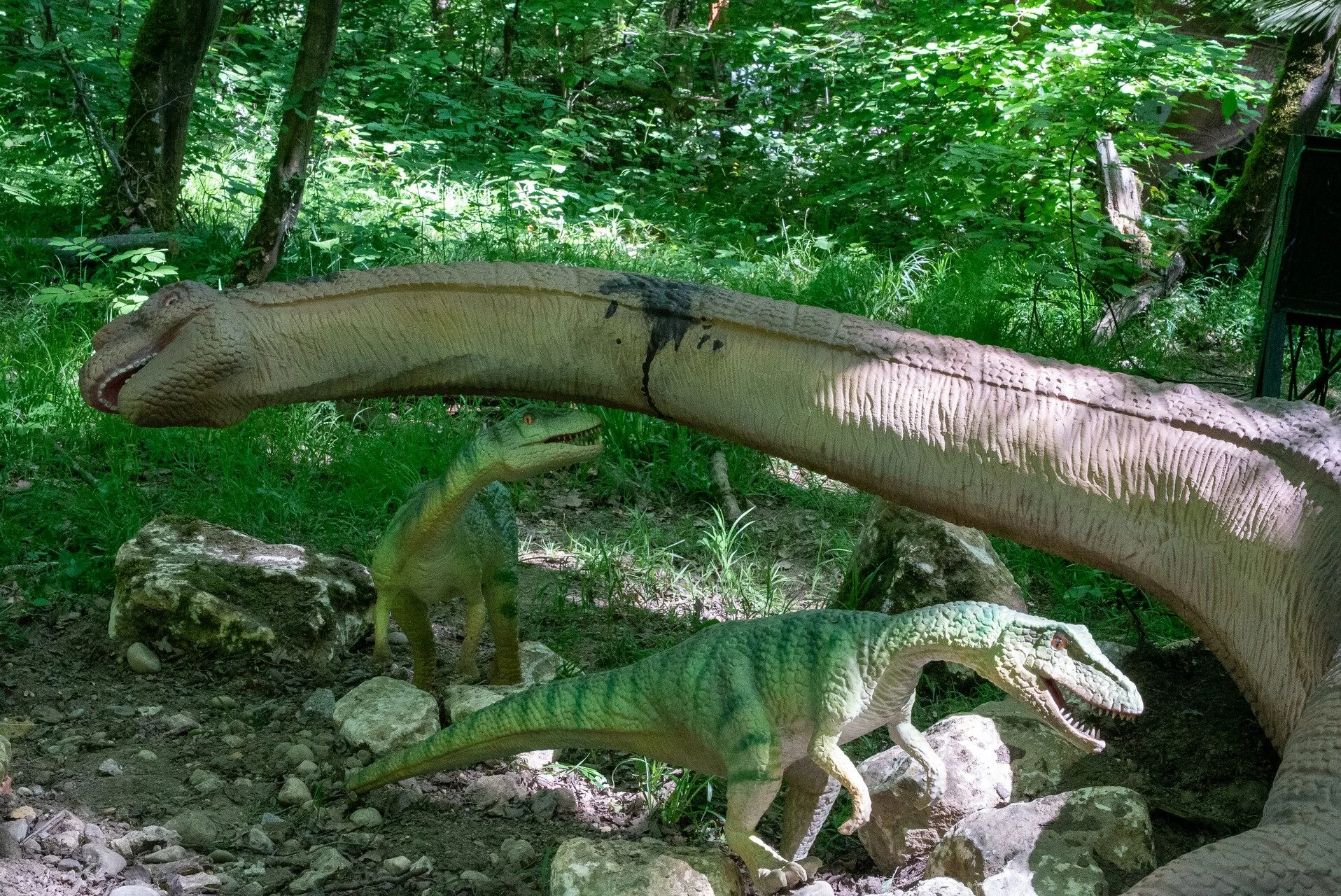

Compsognathus is a small, bipedal dinosaur, fast and agile with long hind limbs and a long tail acting as a counterbalance. It is one of the smallest dinosaurs ever discovered. Its shorter forelimbs were equipped with three fingers bearing long claws, one of which was much longer than the others. This last one was likely used to kill certain prey. It hunted small vertebrates such as small mammals, lizards, or even insects.
A study estimated the running speed of Compsognathus at about 64 km/h, making it one of the fastest bipedal dinosaurs that ever existed.
It has been hypothesized that this species moved and hunted in groups to increase its chances of success. But only two specimens of this dinosaur have been discovered to date, in Germany and France. It is therefore currently impossible to confirm this with certainty.
Its name means “elegant jaw”, highlighting its small size and describing the fine and delicate structure of its jaws.
Compsognathus is part of the suborder theropods, grouping together dinosaurs that stood on their two hind legs. This group is considered to be related to the birds that inhabit our planet today. It has been proven that some bird descendants were potentially small-sized theropods, such as Compsognathus. It is also thought that its skin was covered with a kind of down.
When discovering Compsognathus fossils, a curvature of the neck and tail is observed, which occurs after the animal’s death. The position of the body is thought to be due to the loss of elasticity in a ligament connecting all the vertebrae.