
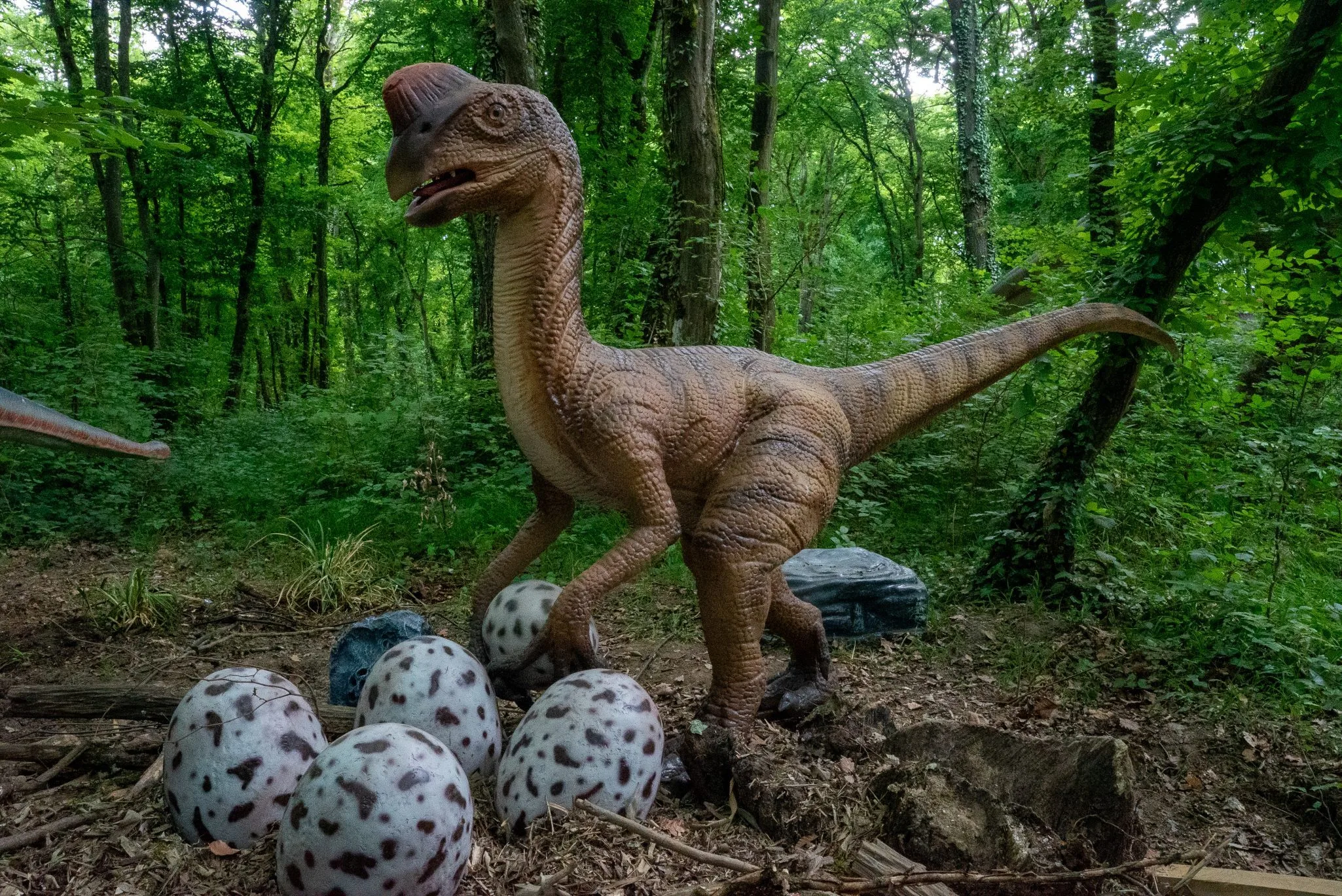

This dinosaur has a relatively short head topped with a bony crest. It has a horned beak with teeth. Its name means “egg thief”, because the first fossils discovered showed the oviraptor with eggs. Scientists concluded it was an egg thief. Later, studies on these eggs showed that they were oviraptor eggs. Far from being a thief, it was actually a protector who brooded its eggs like modern birds do to maintain optimal temperature regulation.
The resemblance does not stop there, as recent studies have shown that this dinosaur had a feathered coat. The structure of its rib cage and its fused vertebrae to support the tail feathers are typical of birds. Moreover, its long fingers allow it to support a feathered wing.
Indeed, recent studies have proposed the hypothesis that all dinosaurs from the theropod group, the ancestors of modern birds, had feathers. Moreover, some scientists think that all dinosaurs had feathers. This is therefore an innovation that appeared in the history of dinosaurs. These feathers served for thermoregulation.