Alligator mississippiensis

Mississippi Alligator

Order: Crocodylia / Family: Alligatoridae / Genus: Alligator

What is a Mississippi alligator?

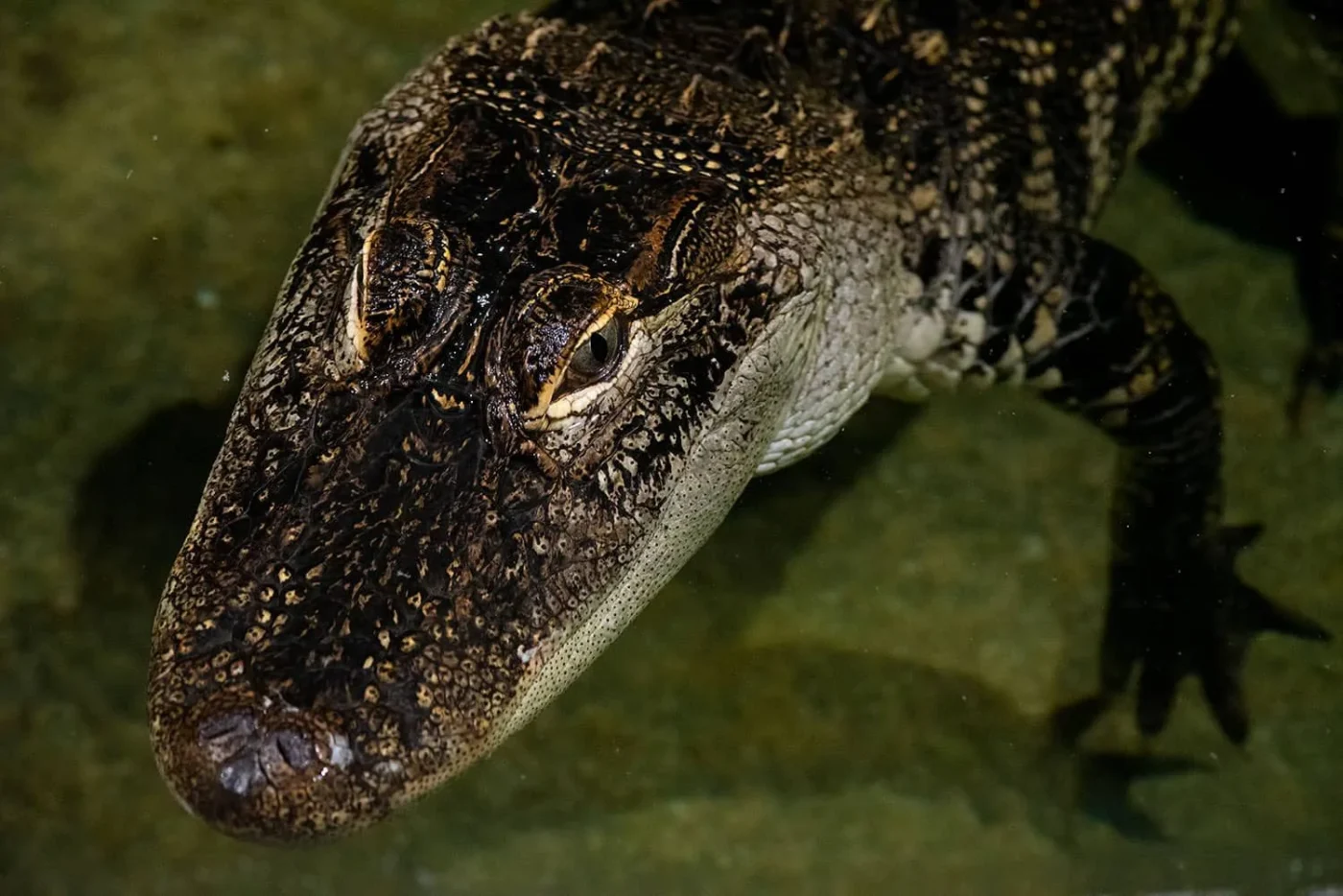
The Mississippi alligator, also called the American alligator, is a reptile with olive-black coloring. It is the darkest species of all crocodilians. The average weight of an individual is 150 kilograms with an average length of 3.5 meters. Generally, males are heavier than females. The largest individual ever recorded weighed 408 kilograms and was 4.36 meters long!

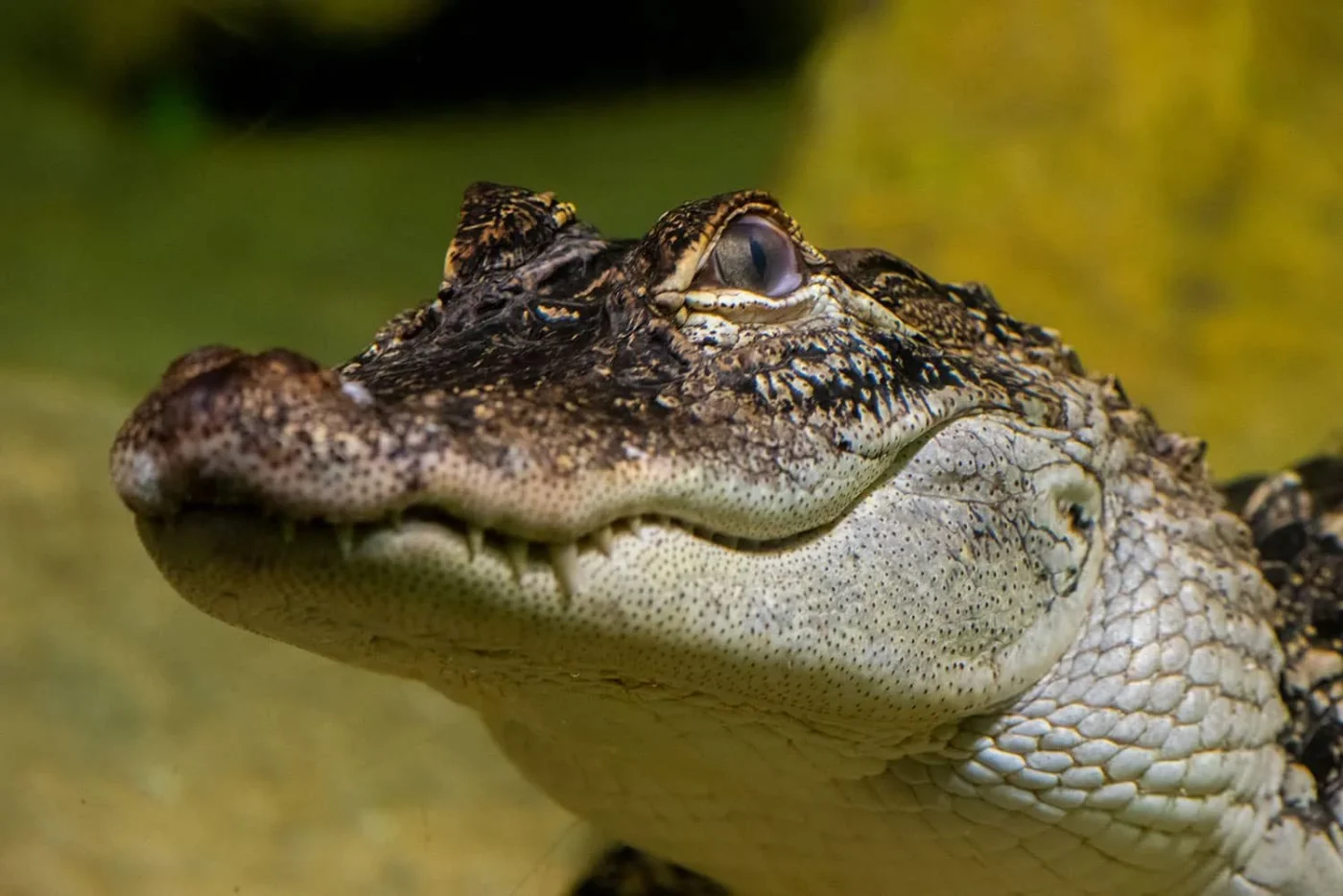
The Mississippi alligator can be recognized by the rounded shape of its jaw when viewed from above. In addition, its upper jaw is larger than the lower jaw, so no teeth are visible when its mouth is closed, or only those from the top or bottom. Unlike the crocodile, whose all teeth are visible when its mouth is closed. It has 80 unique teeth that are continuously replaced throughout its life.

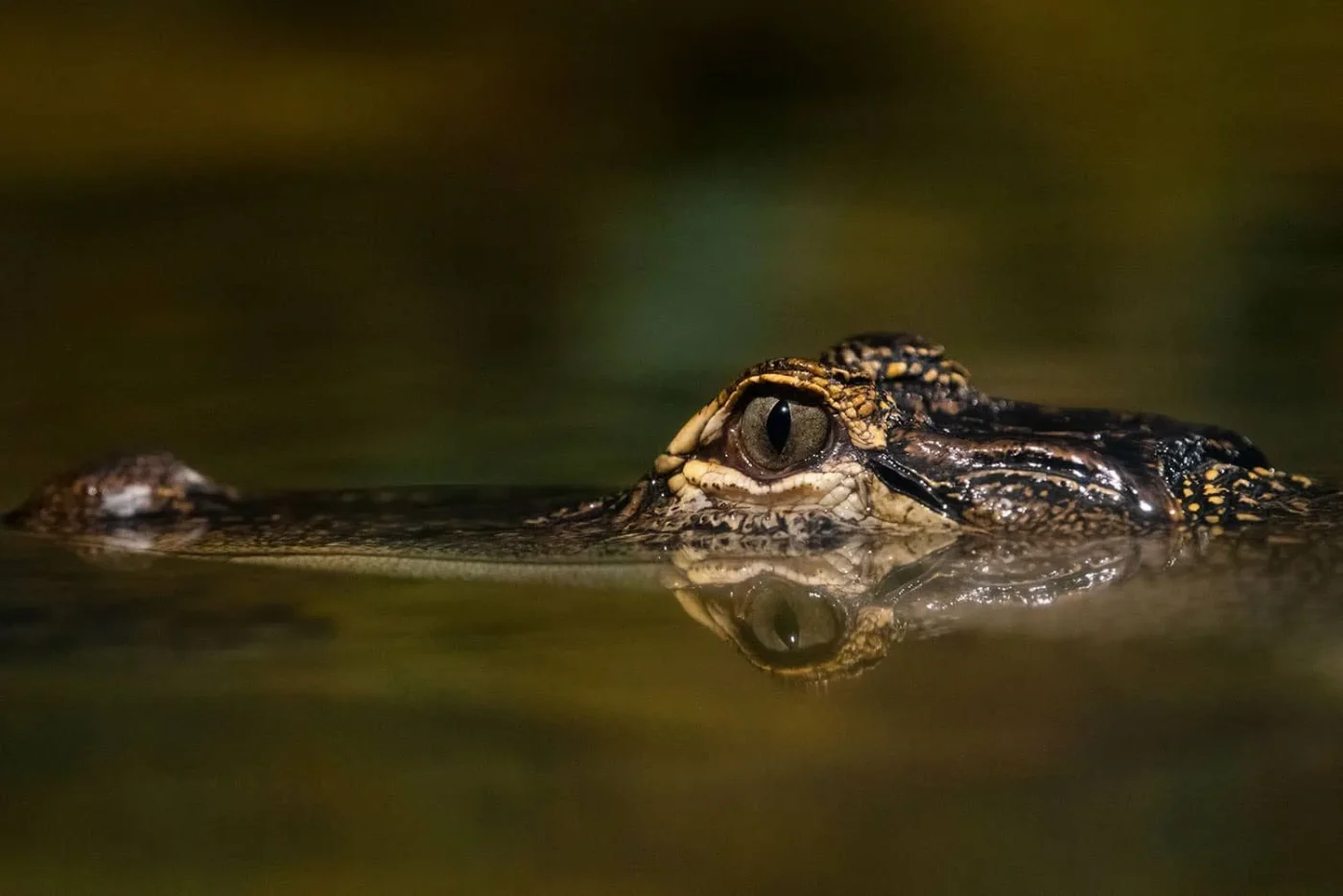
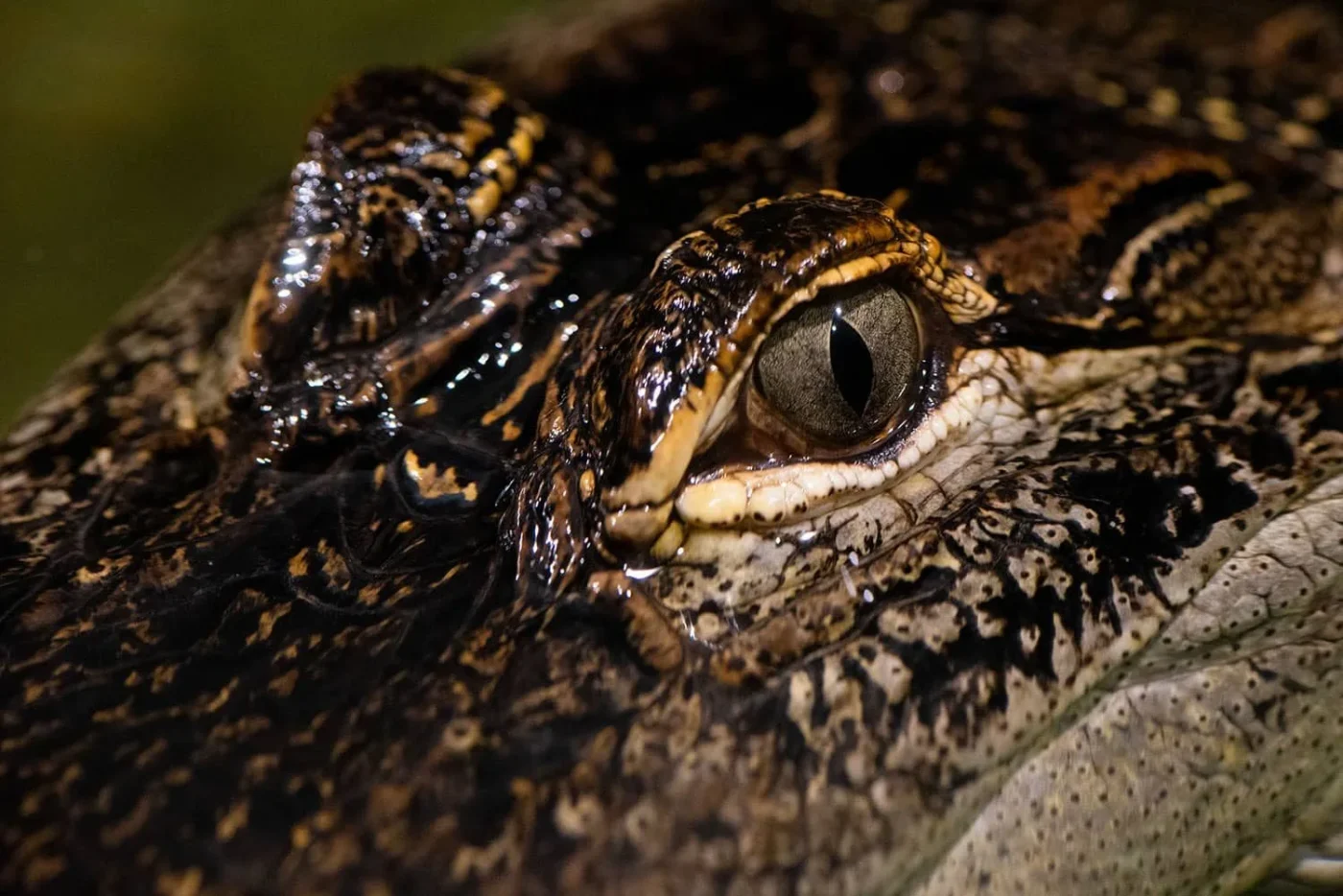
The legs are small but massive, which allows it to move both on land and in water. The eyes are at the top of the skull to allow it to view its surroundings even when it is in the water.

The word alligator is very likely derived from the Spanish word “el lagarto” which means the lizard.

Weight

91 to 360 kg

Habitat

Wetlands, lakes, rivers, marshes

Diet

Carnivore

Gestation

60 days

Longevity

50 years

Longevity

12-17 years

Location

From Florida up to Carolina and Arkansas in the north
Frequently Asked Questions

Where does the Mississippi alligator live?

The Mississippi alligator is the crocodilian species with the northernmost geographic range of all crocodilians. Its range extends from Florida in the south up to North Carolina and Arkansas in the north. They are found as far west as Texas and the northern part of Mexico.

Even though it can sometimes be seen on land, it is primarily an aquatic reptile. It is mainly found in freshwater environments such as marshes, rivers, or lakes. Some individuals do not hesitate to venture into human-modified areas such as swimming pools. Despite their intolerance to salt, some sightings of alligators in lagoons or brackish waters have occurred. Smaller individuals and females are usually found in wetlands so they can hide in vegetation. Large males are mostly present in open water.

What does it eat?

The alligator is carnivorous and eats a wide range of prey. Generally, the bigger it is, the larger the prey it consumes.

Juveniles mainly eat small fish, insects, and invertebrates. Once adult, they consume large mammals such as wild boars, birds, and reptiles.

Numerous predators attack the eggs: raccoons, opossums, black bears, otters, wild boars, and crows. Young ones can be attacked by herons.

Behavior

Alligators are social reptiles that live in small groups whose members seem to have very close bonds.

They are active during the day and behave differently depending on the season. Like all reptiles, they are ectotherms, which means they cannot regulate their body temperature. As a result, in order to maintain an optimal temperature, they must bask in the sun and take refuge in the shade or in the water to avoid overheating. In summer, they bask in the sun early in the morning and late in the afternoon, whereas in winter they take advantage of any ray of sunshine to warm themselves up.

Alligators can burrow into the ground to escape unfavorable weather conditions such as drought or a cold snap, for example. The animal then digs a hole in the mud using its snout and tail in order to take shelter. However, during the winter period, when temperatures are below zero, some individuals remain lying in shallow water with only their nostrils protruding above the surface to breathe and avoid getting trapped under the ice.

They are able to move on land by standing on all four legs; this way of walking uses very little energy.

They can produce sounds both in the air and in the water. Since they have no vocal cords, the sound is produced by inhaling air. Juveniles are very noisy and can yelp in order to attract the attention of adults, especially in case of danger.

Their bodies are covered with small sensory domes 1 mm in diameter, sensitive to touch, heat, and certain chemical compounds. These receptors are called integumentary sensory organs (ISO) and are located around and inside the mouth as well as on the body. These organs allow them to detect changes in pressure and vibrations caused by prey movements.

Reproductive strategy

The breeding period stretches over April and May; at that time, females and males seek potential mates: same size, same age… This search is facilitated by pheromones released by the anal glands.

There are confrontations between the males to determine each one’s territory and female. The fight consists of opening the mouth and projecting upward while vocalizing as loudly as possible with hissing sounds.

Next, in June and July, the nest is built and the female lays the eggs, generally at night. The nest is made of vegetation and peat and is located 3–5 meters from the edge of the water. The female lays between 30 and 50 whitish eggs, oval in shape and measuring 4 x 18 centimeters. The female protects her nest and eggs from predators such as raccoons or bears for example.

The sex of the hatchlings is determined by the temperature at which the egg is incubated during the period between the 25th and 30th day after being laid. A temperature of 31°C or lower produces a female, while a temperature of 33°C or higher produces a male. If the temperature is 32°C, then the sex ratio is 50% males and 50% females.

Incubation lasts about 60 days, and the hatchling breaks the shell thanks to a diamond, which is a sharp modified scale on the head. The young are born at the end of August or the beginning of September.

The young emit squeaks while still underground. In fact, these vocalizations encourage the female to dig the nest to help her young out of the egg. She then uses her paws or her teeth to free the newborns from the shell. Then, gently, she grabs them with her jaw to move them safely into shallow water.

At birth, the young measure an average of 23 centimeters long, weigh 65 grams and have a black coat striped with yellow. During the first days of its life, the hatchling draws energy from the egg yolk still present in its belly. The young stay with their mother for up to 9–12 months, and in some cases can even overwinter with her.

Males and females grow at equivalent rates up to 1 meter; afterward, the female grows more slowly than the male, which is why there is a size difference between the two sexes.

Females grow up to 45 years old and about 2.75 meters, whereas males stop growing at around 3.65 meters. Studies have shown that only 10% of the young reach adulthood.

Sexual maturity is reached at a size of 1.80 meters, that is, between 10–20 years, and the average lifespan is 50 years.


What is it threatened by?

Nowadays, the American alligator is not classified as threatened. However, some individuals fall victim to road and boat collisions, drowning in fishing nets, urbanization, agriculture, and poaching.

Other animals to discover