Equus quagga

Zebra

Order: Perissodactyla / Family: Equidae / Genus: Equus

What is a zebra?

The zebra is an equine, like the horse, which explains their strong morphological resemblance. The main characteristic of the zebra is its black and white striped coat. In fact, contrary to popular belief, the zebra is actually black with white stripes. Indeed, at first, the fetus’ coat is completely dark. The light stripes only appear later in embryonic development.

There are 3 species of zebra on Earth: the Grevy’s zebra (Equus grevyi), the mountain zebra (Equus zebra), and the plains zebra (Equus quagga). This classification is based on morphological differences, such as size and stripe patterns, as well as genetics. The plains zebra is the smallest of the three species, while Grevy’s zebra is the largest.

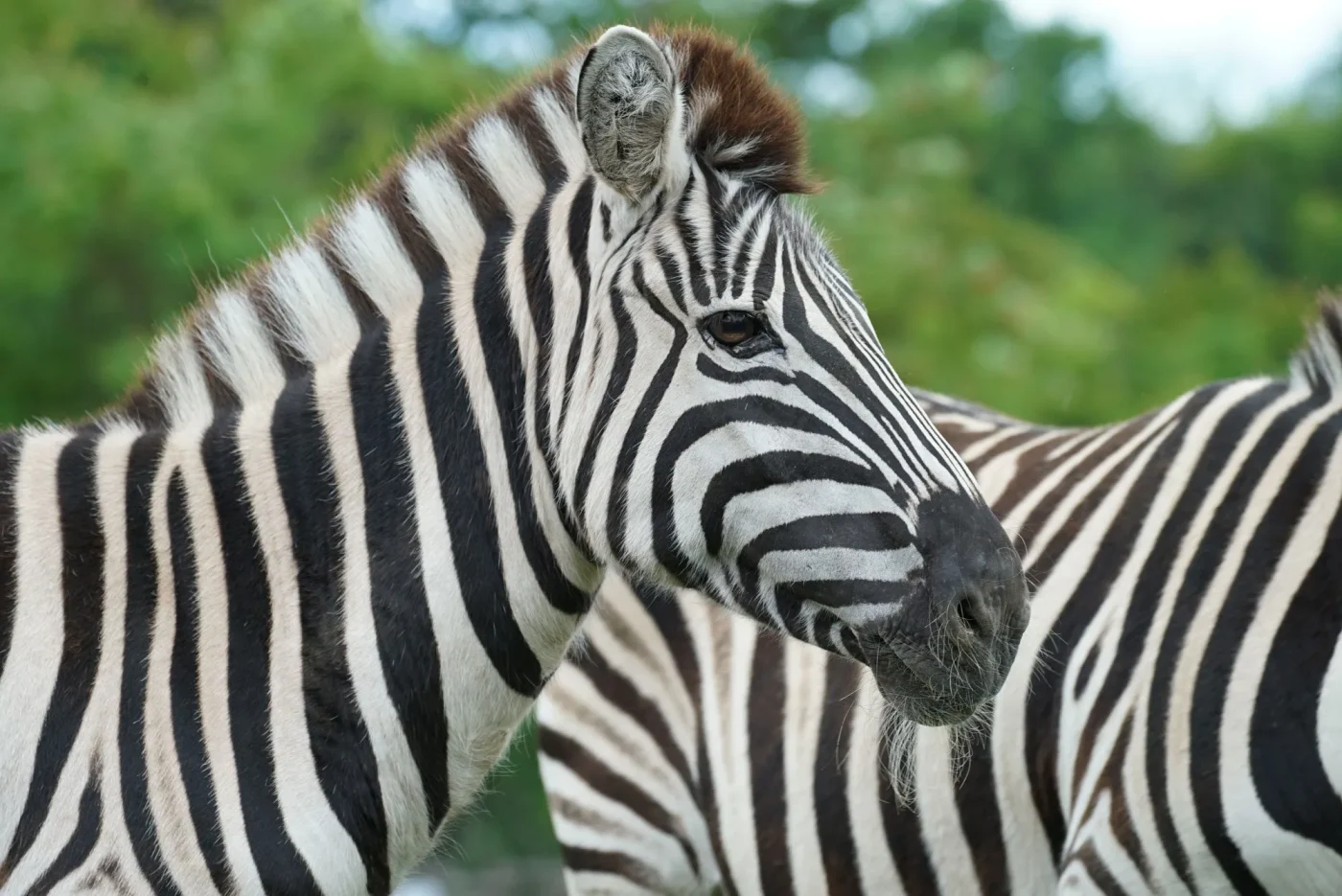
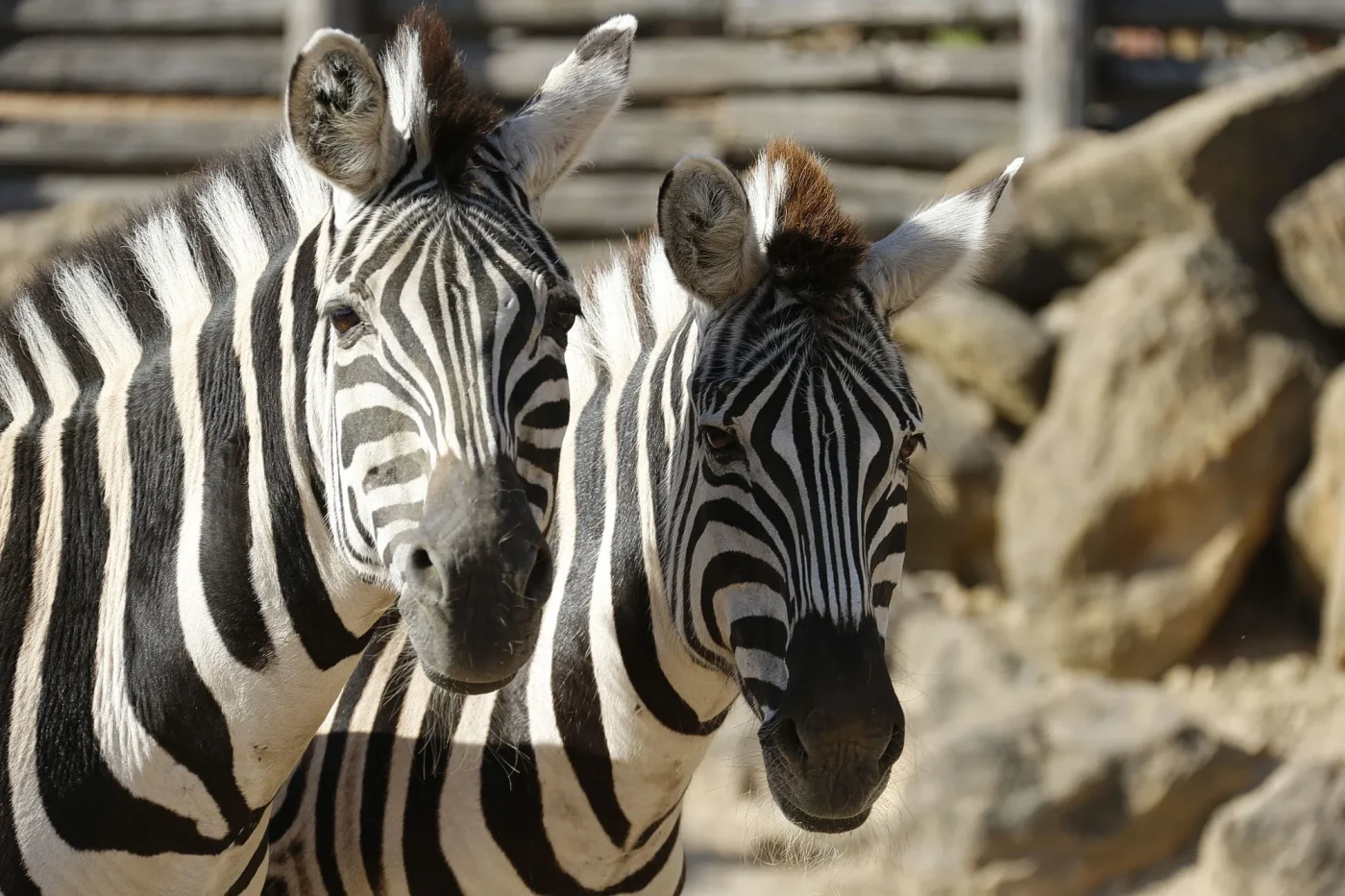
The plains zebra has the widest stripes of the three species. They are horizontal on the rump and legs but vertical on the rest of the body. The stripes meet at the belly. The stripes on the head are both vertical and horizontal. Depending on the subspecies and individuals, it is possible to see brownish ‘shadows’ in the white areas. Each individual has its own black and white pattern, which allows them to be recognized just like our fingerprints.

Plains zebras measure between 2.17 and 2.46 meters long, with a height at the withers of 1.1 to 1.45 meters. Their tail measures between 47 and 56 centimeters. There is no real sexual dimorphism in this species; however, males tend to be slightly more robust and have a thicker neck on average.

The young have a ruffled brownish coat striped with yellowish white.

According to various theories, the zebra’s stripes have a number of functions:

  • A disruptive coloration:
  • The stripes create an optical illusion that makes the zebra appear closer than it really is. As a result, predators pounce too early and miss their target.
  • At night, the black and white colors blend into gray, which allows for better camouflage.
  • The mass of striped patterns makes it harder to single out an individual within the group. This delay gives zebras an advantage during escape.
  • A social advantage: the unique patterns allow individuals to recognize each other, those with more stripes receive more grooming and attention from peers.
  • Thermoregulation:
  • Air moves at different speeds over black (which absorbs sunlight) than over white (which reflects sunlight). This creates thermal circulation that cools the zebra.
  • The black and white pattern would protect against tsetse flies that prefer solid color surfaces.

Weight

200-350 kg

Habitat

Savanna and Prairie

Diet

Herbivore

Gestation

12 months

Longevity

20-30 years

Longevity

12-17 years

Location

From South Sudan down to South Africa
Frequently Asked Questions

Where does the zebra live?

The geographic range of the plains zebra stretches from South Sudan to South Africa. The main populations are found in the Serengeti-Mara plains in Tanzania and Kenya.

They particularly favor open environments such as open plains, open forests, or bushy areas. Even though they can be found in hilly and mountainous landscapes up to 4,000 meters in altitude, they generally avoid dense forests, deserts, and wet areas as much as possible.

What does he eat?

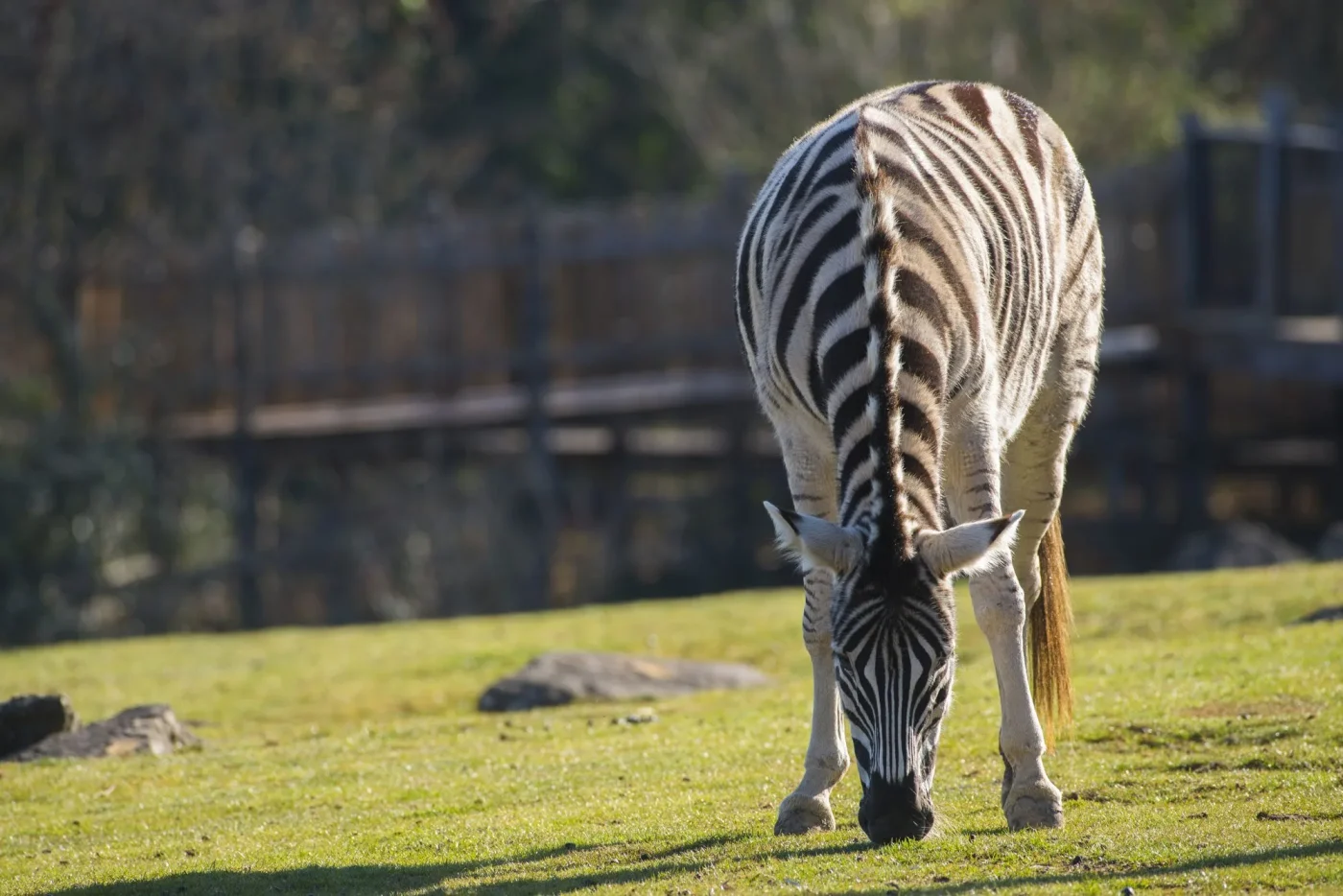
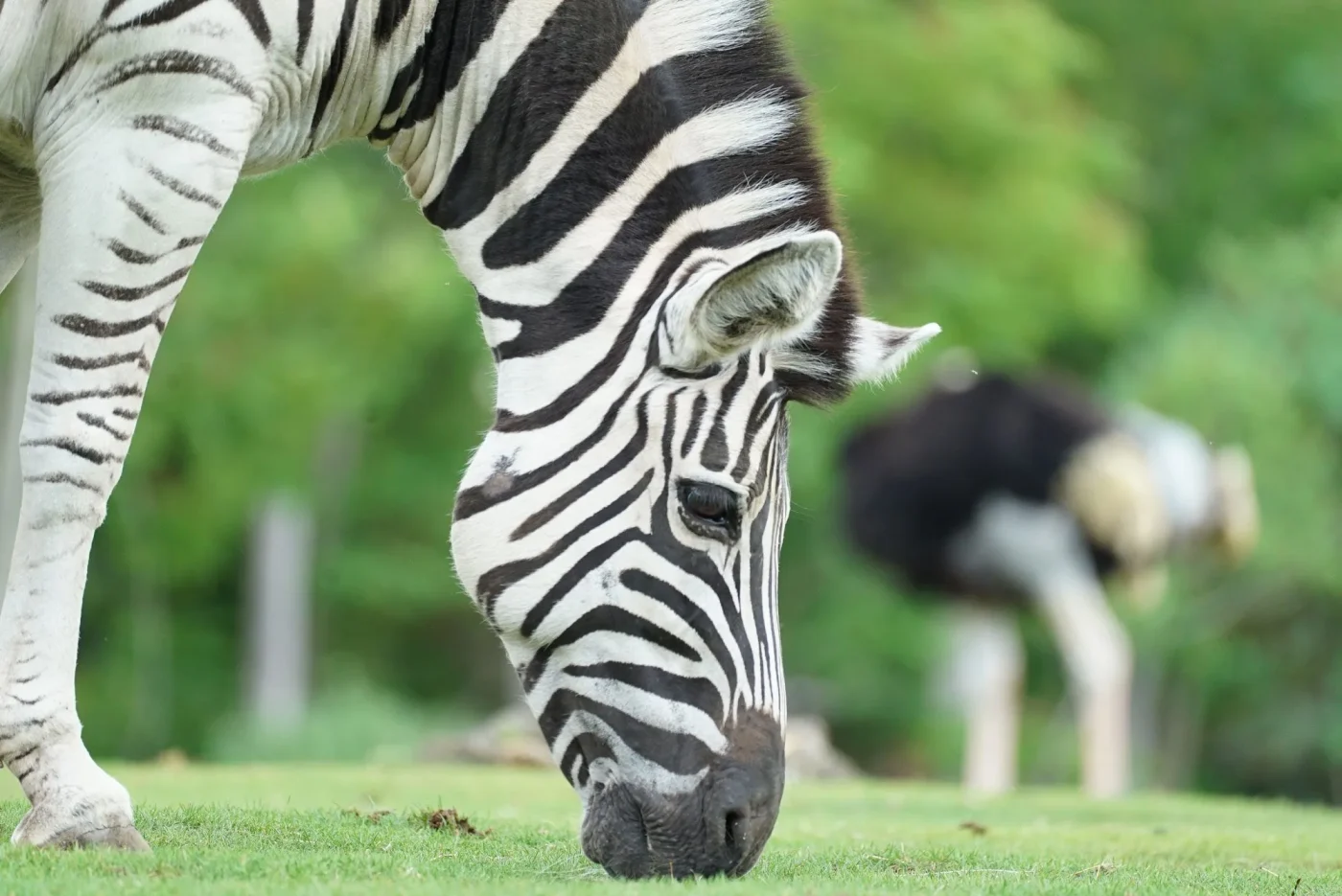
Zebras are herbivorous animals, mostly grazers. They mainly eat grasses but can also consume leaves and stems. The grass is taken with the help of the lower incisors and the upper lip.

They travel an average of 13 kilometers daily to reach resting, feeding, and fresh water areas. Having a great need for water, they hardly ever move more than 10 km away from a water source during the dry season.

Depending on the seasons and food availability, harems gather to form large herds in order to undertake long migrations of nearly 3,000 kilometers.

Zebras play an important role in the stability and dynamics of pastoral communities. Indeed, their migrations, trampling, and feeding help stimulate the growth of young shoots and increase the quality and quantity of vegetation.

The predators of zebras are lions, spotted hyenas, wild dogs, cheetahs, leopards, and Nile crocodiles. The stallion defends the group with kicks, hoof strikes, and bites. At night, at least one individual stands guard. They can also rely on their stripes, which provide better camouflage at night and confuse predators. The mass of striped patterns makes it harder to single out a particular individual within the group. This delay gives zebras an advantage when fleeing, where they can even reach speeds of 88 km/h.

Reproduction strategy

Plains zebras have a polygynous reproductive system, which means that one male mates with several females. Males form harems, and there doesn’t seem to be competition between males—once a female is with a male, no one else will try to take her. At the first estrus, young females signal to the males their availability for reproduction through urine and a particular posture. From then on, males attempt to “take” the mare from her birth group. They try to attract her using grooming to bring her into the harem. This is the only time when there is competition between males. It is also on this occasion that a single male can start to form his own harem.

Plains zebras can reproduce throughout the year, but there appears to be a birth peak in the rainy season between October and March. The gestation period is about 12 months, and the female gives birth to one foal at a time. Birth happens away from the group, well hidden from predators. The foal weighs on average 32 kilograms at birth, stands on its legs after 10-15 minutes, and is able to follow its mother a few hours after birth. Ten days after giving birth, the female comes into heat again and 50% of them are fertilized again. This phenomenon is known as “foal heat.” It is therefore not unusual to observe a female with two foals at the same time.

The foal suckles from its mother until it is 7 to 11 months old and becomes independent at around 1 to 3 years old, when they leave the group. Unfortunately, only one out of two foals survives, due to predation, disease, malnutrition, or drought.

Even though sexual maturity occurs between 1.5 and 2 years, they only begin to reproduce around age 4.

It is not uncommon to observe cases of infanticide or foeticide in plains zebras. In fact, when a male takes control of a harem, it is common for him to kill young foals and force the females to abort through forced copulation, in order to only invest energy and parental care in his own offspring.

The average lifespan is 20 years in the wild, while in captivity they can live up to 40 years.

Behavior

Plains zebras are social animals that live in harems consisting of an adult male, called the stallion, one to six females, the mares, and their young. The females form the base of the group and stay together no matter what, even when the stallion leaves the group. There is a hierarchy within the harem with the male at the top, followed by the females, then the young. The rank of the foals depends on that of their mother.

The young stay in their birth group until roughly 1 to 4 years old. The males then join bachelor groups, which can be composed of up to about fifteen members.

The need for fresh water and pasture forces zebras to migrate over hundreds of kilometers every year. At this time, harems gather into vast herds. Blue wildebeest and gazelles also join them. Together, they undertake the largest terrestrial migration in the world, during which they move nearly 3,000 kilometers between the Serengeti in Tanzania and the Masai Mara in Kenya.

Among zebras, there is a social grooming practice called allogrooming, which involves maintaining the body or appearance of others of the same species, and it is practiced especially between the mother and the foal and between the male and the females. This grooming is performed by two individuals standing head to tail to eliminate parasites such as flies.

At least six vocalizations have been recorded in plains zebras: three to alert of danger, one for injuries, one in case of distress, and one for contact between members of the same species. Communication is also carried out through facial expressions, scents, and contact.

Conservation

Currently the IUCN classifies the plains zebra as near threatened. Unfortunately, populations are impacted by habitat loss and illegal hunting.

Agriculture destroys grazing areas and blocks migrations.

Even though it is illegal, hunting for skin and meat is still practiced and causes a decrease in the population.

Other animals to discover