
Petaurus breviceps

Sugar glider

Order: Diprotodontia / Family: Petauridae / Genus: Petaurus

What is a sugar glider?

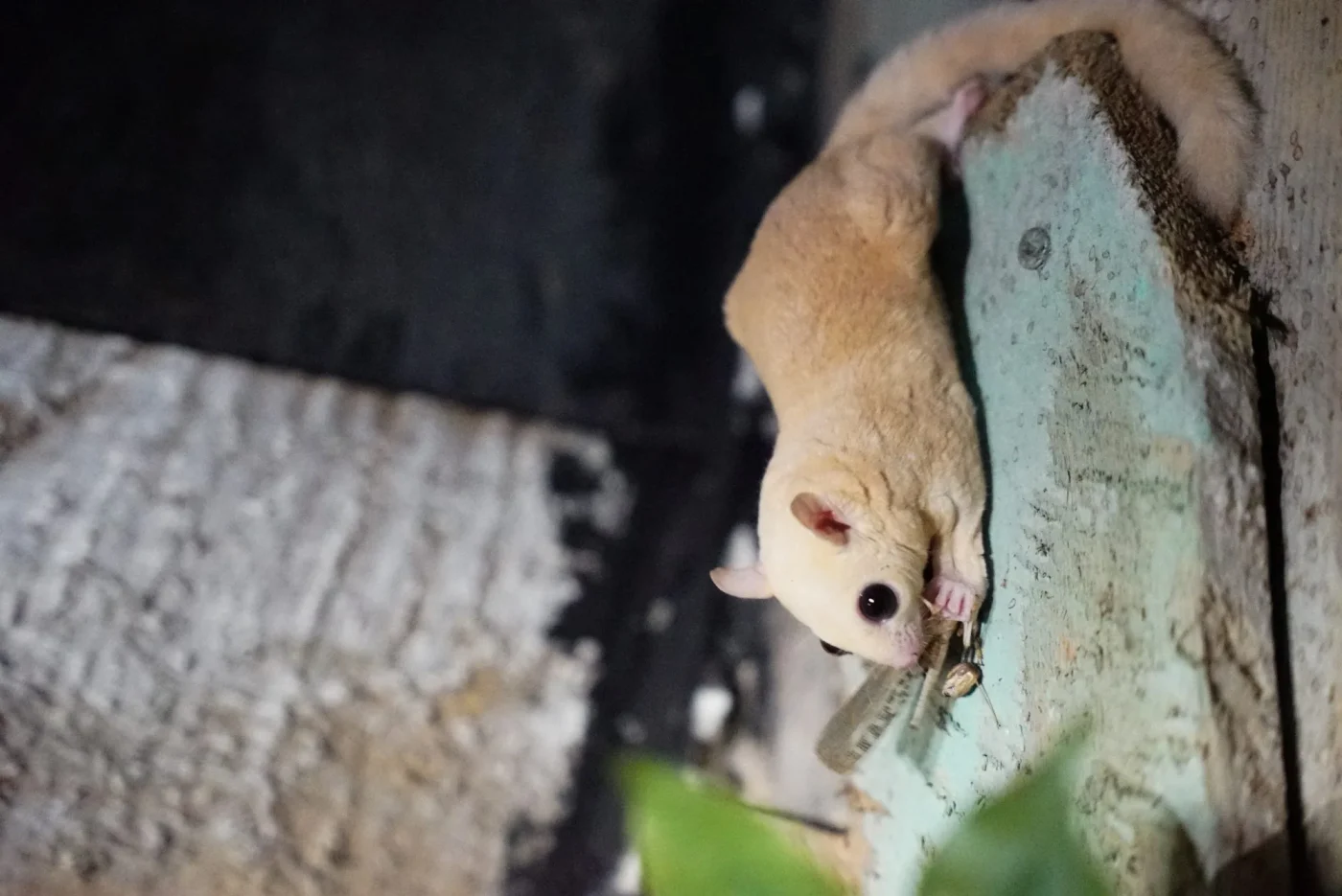
Sugar gliders are small marsupials that measure between 15 and 30 centimeters in length. The rather gray fur on their back features a black stripe that runs from the nose to the tail. They have a patagium, which is a thin membrane of skin that stretches from the last finger of the front paw to the first finger of the hind paw.

Weight

110 grams

Habitat

Forest and savannah

Diet

Omnivore (eucalyptus sap, pollen, nectar, insects and their larvae, arachnids, and small vertebrates)

Gestation

16 days + 70 days in the pouch

Longevity

14 years

Longevity

12-17 years

Location

New Guinea, Bismarck Archipelago, and Australia.
Frequently Asked Questions

Where does the sugar glider live?

The range of the sugar glider extends to the north and east of Australia, as well as islands such as New Guinea and the Bismarck Archipelago.

It lives in various types of forests, which it frequents as long as food is abundant.

What does it eat?

Sugar gliders are omnivores. In spring and summer, they feed mainly on insects, moths and beetles, larvae, arachnids, and small invertebrates. In contrast, during autumn and winter months, they feed on plants, such as eucalyptus sap and pollen.

Behavior

Flying phalangers live in mixed groups of about ten individuals within a territory marked olfactively by the dominant male thanks to scent glands located on the paws and the anus. Other scent glands located on the forehead and chest allow males to mark other group members. Members of the same group never fight; conflicts usually stop at threatening behavior. However, a foreign individual who does not have the group’s scent will be violently attacked if it enters already occupied territory. Flying phalangers have many vocalizations that allow them to communicate with each other. For example, at the first sign of a threat, they emit a vocalization that sounds like the bark of a small dog.

To move around or escape a predator, they can glide from one tree to another over a distance of 45 meters thanks to their patagium.

When, in certain regions, the weather gets too cold or periods of food shortage last too long, the phalanger can fall into a brief state of hibernation.

Reproductive strategy

The dominant male, larger than the other males, is the one who mates the most. After 16 days of gestation, the female gives birth to 1 or 2 babies. This very short gestation is explained by the fact that flying phalangers are marsupial mammals. This means that the young complete their development over 70 days in the mother’s pouch. Then the young remain in the nest for another 3-4 months until they are independent. If some young stay too long, the female may become more aggressive toward them and push them to leave. As long as the previous young has not left, the female will not give birth to new babies.

What are its threats?

Even though it is not currently threatened, the sugar glider is caught to supply the pet market in America. In addition, deforestation for agriculture and forest fires are destroying its habitat.

Discover other species from Oceania: emu, Bennett’s wallaby, kea.

Other animals to discover