Ceratotherium simum

White rhinoceros

Order: Perissodactyla / Family: Rhinocerotidae / Genus: Ceratotherium

What is a rhinoceros?

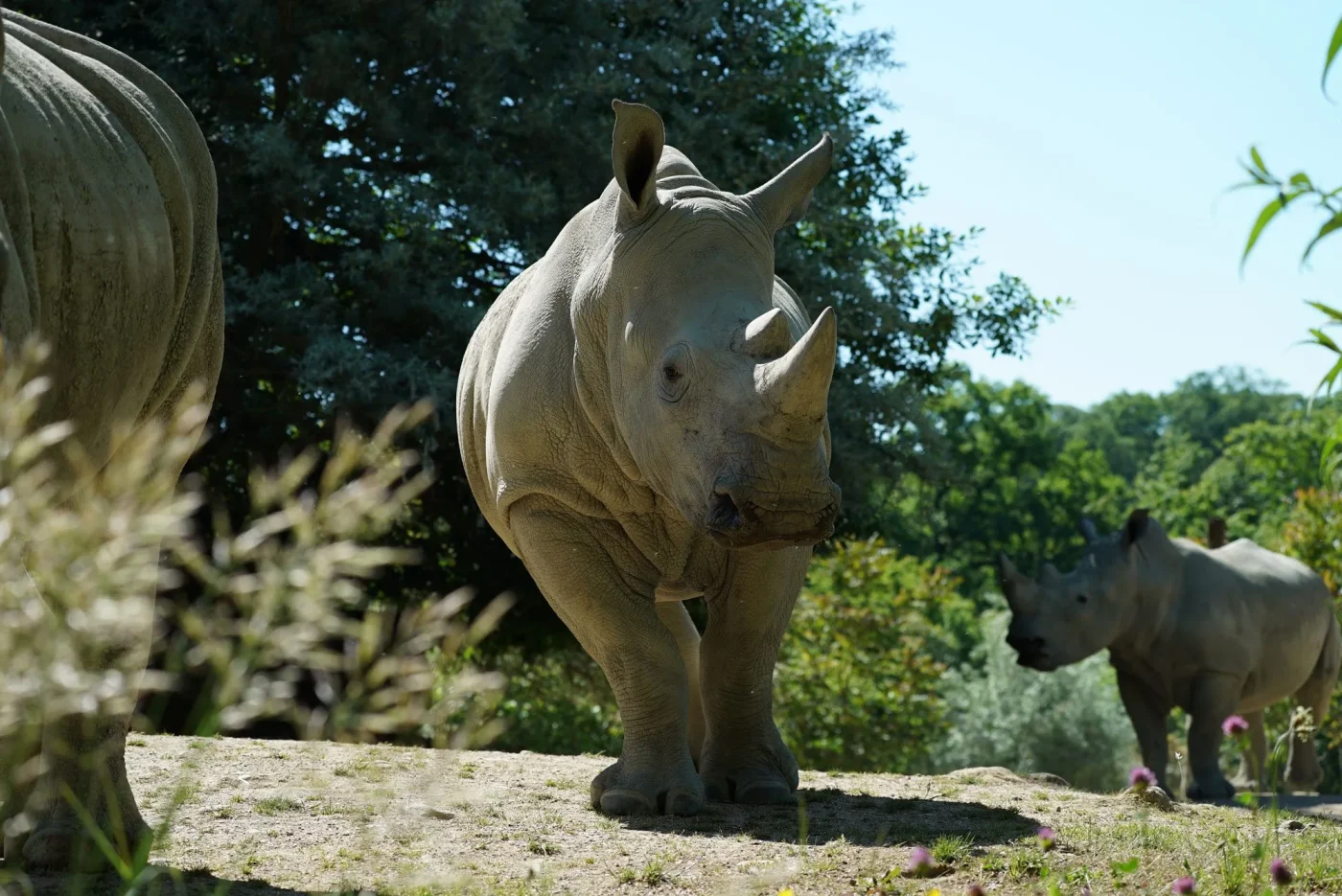
The white rhinoceros is among the largest terrestrial mammals in the world. Its common name refers to a color, like the black rhinoceros. However, both species have grayish skin. The name “white rhinoceros” may be due to a mistranslation of the Dutch word “wijde”, meaning “wide”, which was translated as “white” in English. In fact, the white rhinoceros has a wide, square mouth that allows it to graze on grass and shrubs. The black rhinoceros, on the other hand, has a pointed upper lip enabling it to grasp branches and leaves at height.

As a result, it has large neck muscles to support the weight of its head, which is constantly oriented downward. Females weigh between 1,800 and 2,000 kg, while males can weigh up to 3,500 kg. They measure between 3.30 and 3.70 meters long and have a shoulder height between 1.50 and 1.80 meters at the withers.

White rhinoceroses only have hair at the tips of their ears, at the end of their tail, and on their eyelashes.

They have two horns at the end of their snout. With an average size of 60 cm, the front horn is generally the largest and can even measure up to 1.60 m. These formidable weapons are made of keratin (like hair and nails) and grow throughout their lives.

Weight

1000 - 3500 kg

Habitat

African savanna and grassland

Diet

Herbivore

Gestation

16 - 18 months

Longevity

50 years

Longevity

12-17 years

Location

South Africa, Kenya, Namibia and Zimbabwe
Frequently Asked Questions

Where does the rhinoceros live?

Almost all white rhinoceroses live in Southern Africa, distributed between Namibia, South Africa, Kenya, and Zimbabwe.

Life in the zoological park

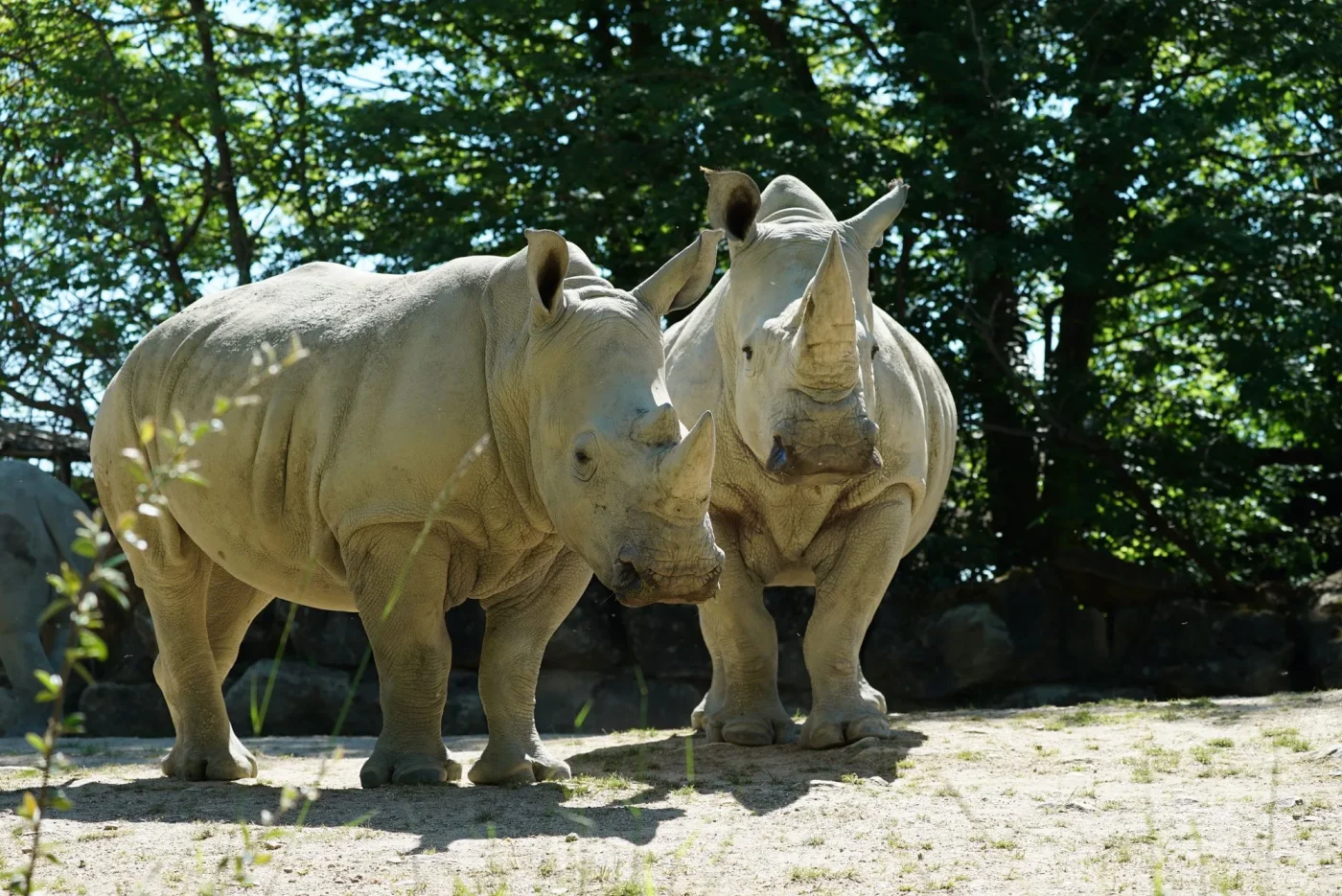
At Amnéville Zoo you can observe our group of rhinoceroses, made up of a breeding male named Benny and 4 females: Yoruba, Hekaw, Tala, and Lucie. Between 2020 and 2021, our veterinarians were delighted to discover that 3 of our 4 females were pregnant.

Reproductive strategy

The mating system is polygynandrous for this species, which means that both males and females mate with multiple partners. Females, having territories larger than those of the males, move from the territory of one male to another, mating with a male when they are in heat. The male uses his olfactory glands to detect, thanks to the urine, females in heat. From then on, he stays with her for 20 days until the moment she accepts mating. During copulation, which lasts between 15 and 30 minutes, the male ejaculates every 4 to 5 minutes. Typically, mating occurs over 2 to 5 days.

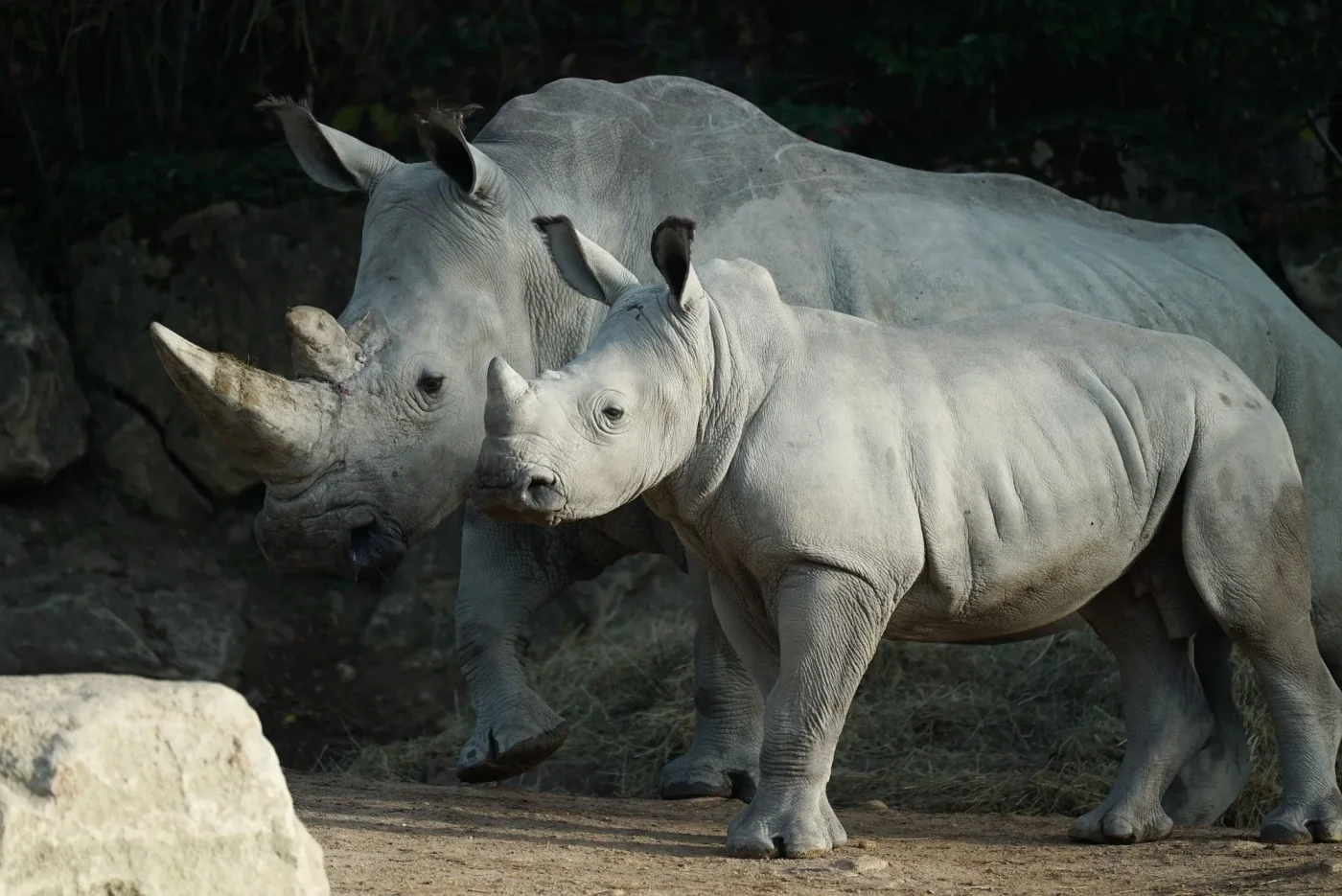
After a 16-month gestation period, the female gives birth to a single calf at a time, which weighs about 40 kg at birth. Only the mother looks after the calf, with no parental care from the males. The calf starts grazing around 2 months old but will not be weaned until about one year of age. The calf is generally chased away by its mother around the age of 3 years. From that moment on, the female is available again to mate with a male. Females reach maturity around 6-7 years old, while males do so only around 10-12 years old. White rhinos can live up to 50 years.

What does it eat?

White rhinos are herbivores and mainly grazers. They primarily eat grass but can also eat fruits, leaves, or seeds. The presence of rhinos helps prevent the spread of fires. Indeed, grazed-down grass no longer allows fire to spread to other plants.

These animals have a great need for water and usually drink water twice a day.

Lifestyle

They are semi-social animals active during the day or at dusk. Males are solitary and territorial, while females group together in small groups of 6 individuals. Males have small territories of 1 to 3 square kilometers. On the other hand, females have large territories of 6 to 20 square kilometers. Territorial marking is done olfactorily using urine and droppings.

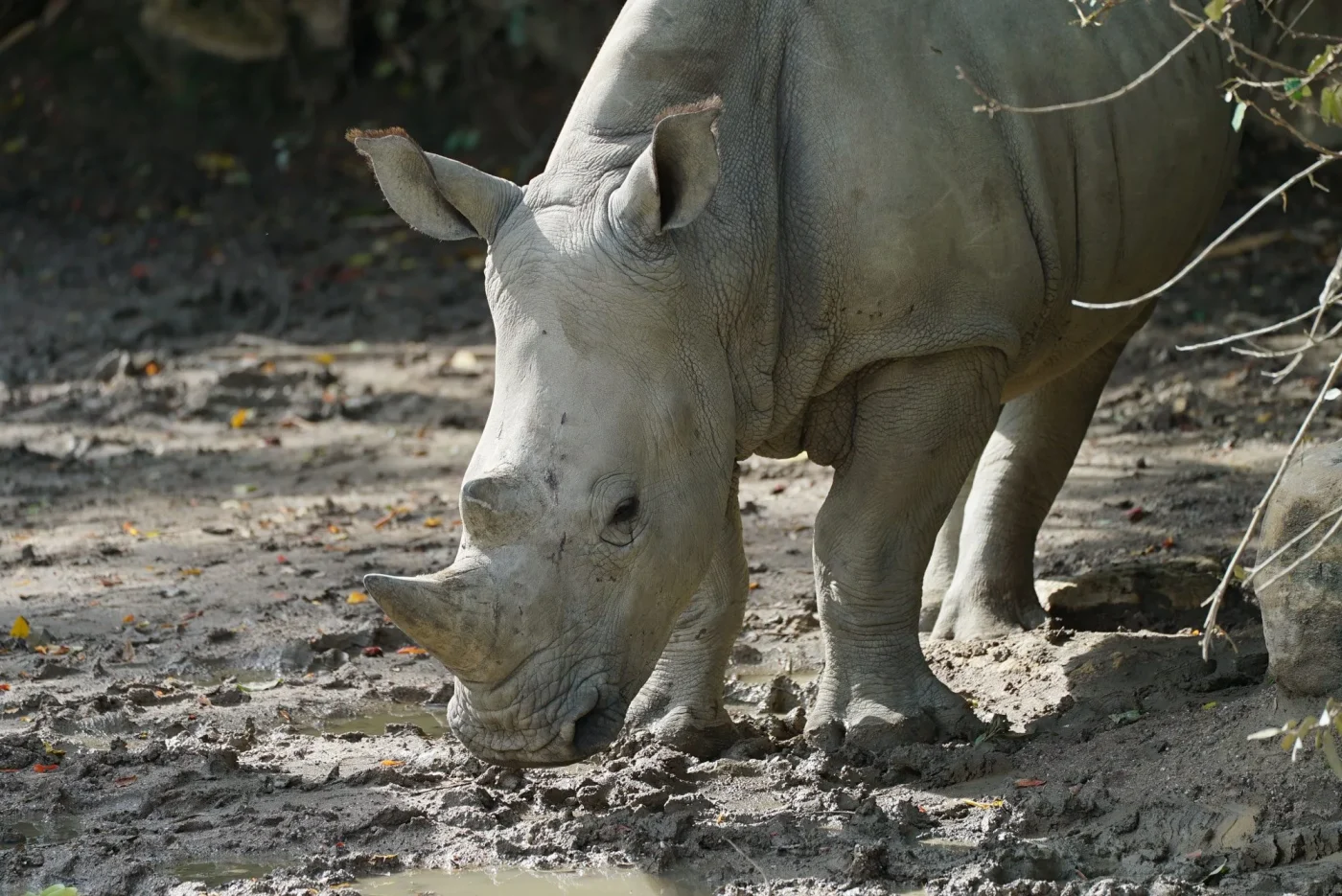
During the summer, it is not uncommon to find them near water points wallowing in mud. This helps to cool their bodies and also to protect their skin from the sun and from parasites. For this reason, rhinoceroses are the color of the ground on which they live. They share a mutualistic relationship with various bird species such as oxpeckers and starlings. The birds feed on the parasites found on the rhinoceroses’ skin, thus ensuring their good health. In return, the rhinoceroses offer protection and food to the birds.

The white rhinoceros is a calm and shy animal, with a highly developed sense of smell and hearing. Their eyesight, on the contrary, is rather poor. This is what earned them a bad reputation as an aggressive animal. Indeed, as soon as it senses danger, it charges to defend itself, not knowing exactly what is in front of it. Despite its build, it can reach speeds of 40 km/h.

Distinguishing features

Its horns, formidable weapons, are made of keratin and will grow throughout its life. The front horn generally measures 60 cm but can reach up to 1.5 meters.

While its common name refers to its color, as with the black rhinoceros, these two species actually share the same grayish color. The name ‘white rhinoceros’ is actually due to a translation error of the Dutch word “wijde,” meaning “wide,” which was translated as “white” in English. In fact, the white rhinoceros, which is larger, has a wide and square mouth to be able to graze on grass and shrubs. Meanwhile, a black rhinoceros has a pointed upper lip, which allows it to grab branches and leaves in high places.

What are its predators?

Due to their size and strength, adult white rhinos have no predators. However, young ones can be targeted by lions and occasionally by hyenas.

What threatens it?

The rhino population is impacted by poaching. It is estimated that a rhino is killed every 22 hours, proof that their conservation is a priority. The year 2015 was the deadliest, with 1,349 rhinos poached on the African continent. Since 2008, 11,000 African rhinos have been poached. Unfortunately, in 2021, the Covid-19 crisis led to a 13% increase in poaching compared to 2020.

These animals are illegally killed for their horn, which is used in traditional Asian medicine. Trophy hunting, habitat loss, and climate change—which leads to water scarcity—also impact populations.

Rhino horn has been used in traditional Asian medicine for over 2,000 years. Its uses are very diverse: treatments for fever, rheumatism, snake bites, headaches, or food poisoning. When used, the horn is shaved or ground into powder, then dissolved in boiling water and consumed. To this day, no scientific study has proven the effectiveness of rhino horn as a treatment. Unfortunately, more and more, rhino horn is being used to demonstrate professional success and social status.

Population

Today, there are about 20,000 white rhinos compared to only 5,000 black rhinos and fewer than 3,500 Indian rhinos. The Javan and Sumatran rhinos are the most threatened and are nearly extinct with less than 100 individuals per species remaining.

Anecdote

Rhinoceroses can reach 40 km/h and share a mutualistic relationship with various bird species such as oxpeckers and cattle egrets. The birds feed on parasites found on the rhinoceroses’ skin, thus ensuring its good health, and in return, the rhinoceros offers protection and food to the birds. They are fond of mud or sand baths during the summer. However, it is rare to see them swimming.

Other animals to discover