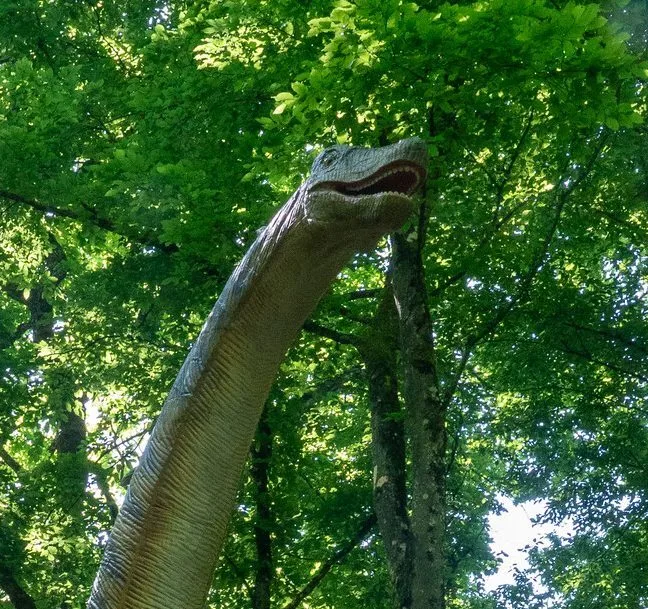
Sauropods are dinosaurs whose family is distinguished by their large size, long neck, long tail, and herbivorous diet, just like the diplodocus. These specimens were the largest of all dinosaurs and possibly also the largest animals that have ever lived on our planet.
It is believed that this species, like many sauropods, lived in groups.
The long neck allows it to find as much food as possible without having to move, which enables a significant energy savings for an animal of this weight. It uses its pencil-shaped teeth to tear leaves from trees. It is also thought that a neck of this size allowed individuals to fight amongst themselves for reproduction, similar to giraffes.
It also seems that the long tail could be used like a whip to face predators.
Today, it is still difficult to understand how these dinosaurs were able to support a neck of that size, the number of muscles necessary for support, or how air and blood circulated between the head and the body.
Weighing between 10 and 16 tons, with most of the weight located around the abdomen, without such a long tail and a long neck, the legs would not have been able to support such a heavy load. Both the neck and the tail act as counterweights by acting on a ligament that runs along the spine. The weight of the tail and the neck allowed the ligament to stay tense, in order to straighten the spine and support the abdomen.
0;
Diplodocus comes from the Greek diplous, “double,” and docos, “beam.” Contrary to what one might think, its name does not refer to the shape of its body, but rather to bones located under the caudal vertebrae. Seen as two beams supporting each other in the shape of a V, it is believed they protect the blood vessels underneath the tail.