What is a mandrill?
The mandrill is part of the Cercopithecidae family, like the drill or the baboon. They are Old World primates and live only in Eurasia and Africa. They are distinguished from New World primates by their morphology. Those from the Old World have close-set nostrils and a non-prehensile tail, unlike those from the New World, who are present on the American continent, such as marmosets, tamarins, etc.
He lives in large groups called a horde, usually between a few individuals and up to around fifty. The largest group was observed in Gabon, where about 700 mandrills occupied a territory of 182 km2. Perfectly adapted to a terrestrial life, the mandrill spends the day on the ground to find food as well as to conduct most of its social interactions. At night, it takes refuge up high in the trees to rest.
The social structure and communication are obviously very developed in the mandrill. However, it is a difficult animal to observe and studies on this subject are lacking. Recently, scientists have highlighted the fact that the mandrill lives in multi-male, multi-female groups unlike baboons or geladas which live in harems (a group of females and their young led by a dominant male). This type of group promotes access to food, protection against predators, as well as reproduction.
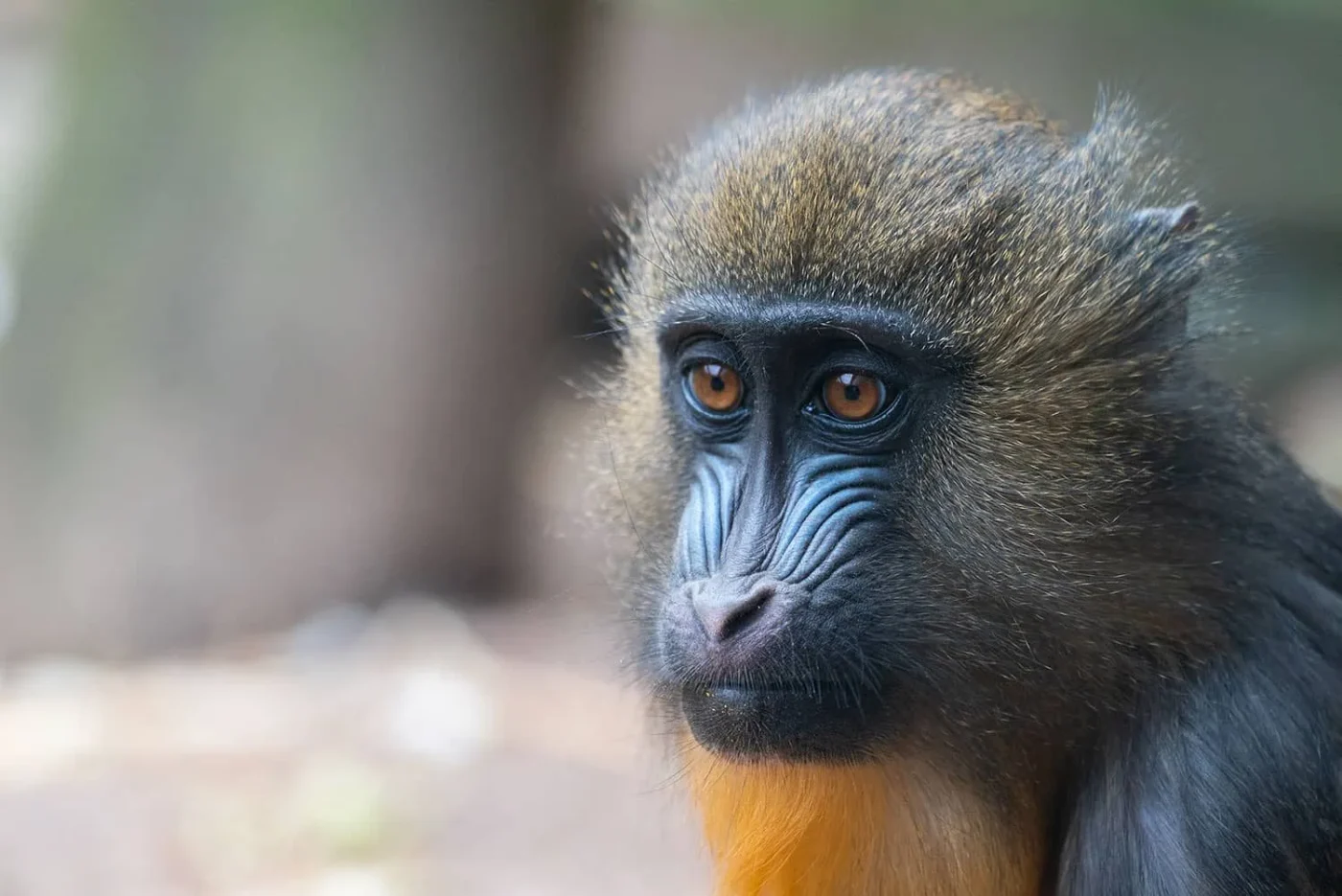
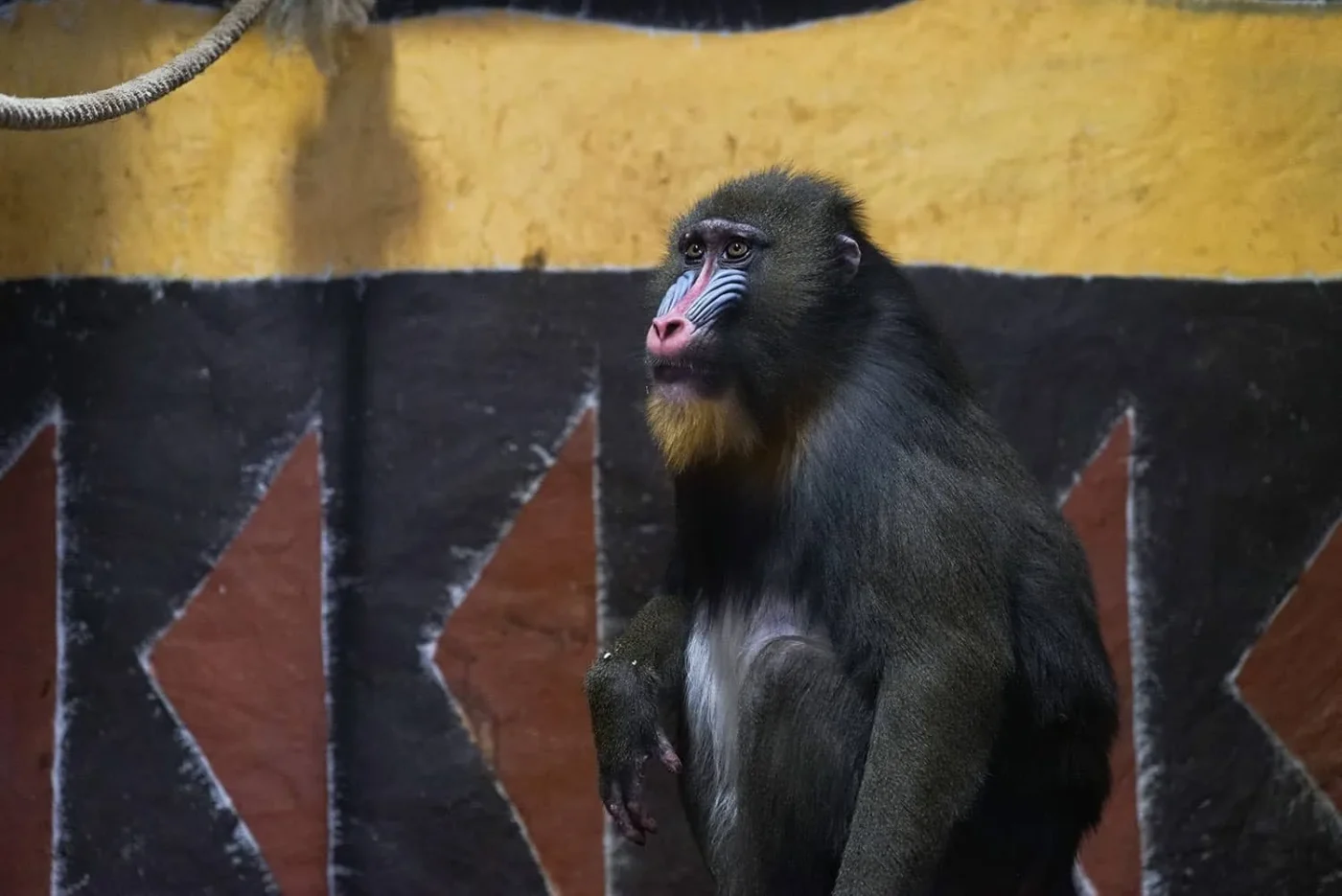
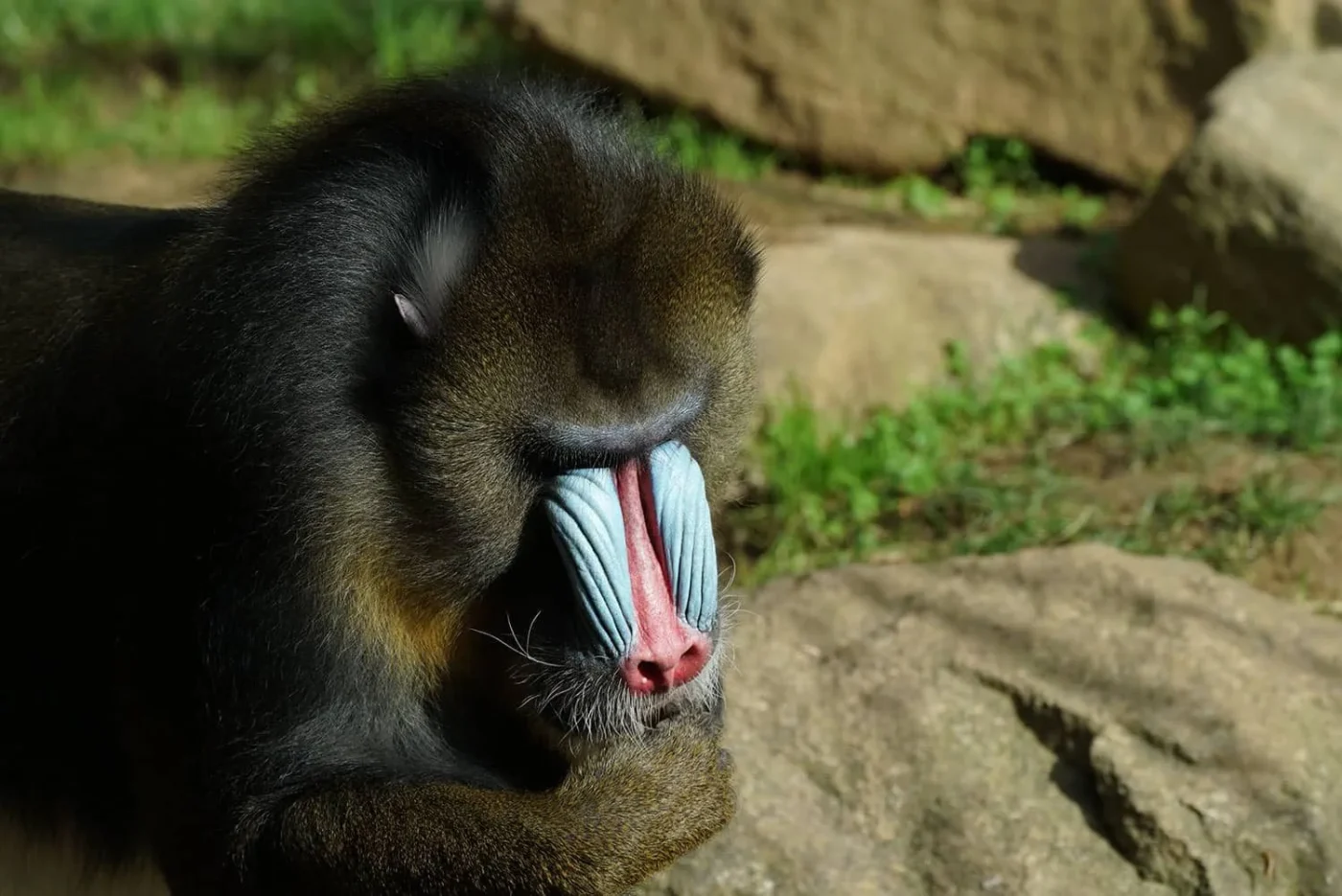
There is a strong sexual dimorphism in this species; the male is twice as big as the female, with a larger skull structure and more vivid colors. However, both have a yellow beard, a snout colored with red and blue bands, and blue-violet colored rumps.
The different colors of their bodies are actually at the heart of their social system. The higher a male rises in the hierarchy, the higher his testosterone level and the brighter the colors become. Conversely, if a male loses his rank, the colors become duller and his hormone level decreases. Another example: when the blue color of their rump intensifies, it is a sign of excitement. This mode of communication is accompanied by visual, tactile, olfactory, and acoustic communications. For example, yawning indicates discontent; if he shakes his head and shoulders, it is an invitation to grooming; and the grimace, by baring his lips, which is a sign of appeasement.