
Nestor notabilis

Kea

Order: Psittaciformes / Family: Strigopidae / Genus: Nestor

Description

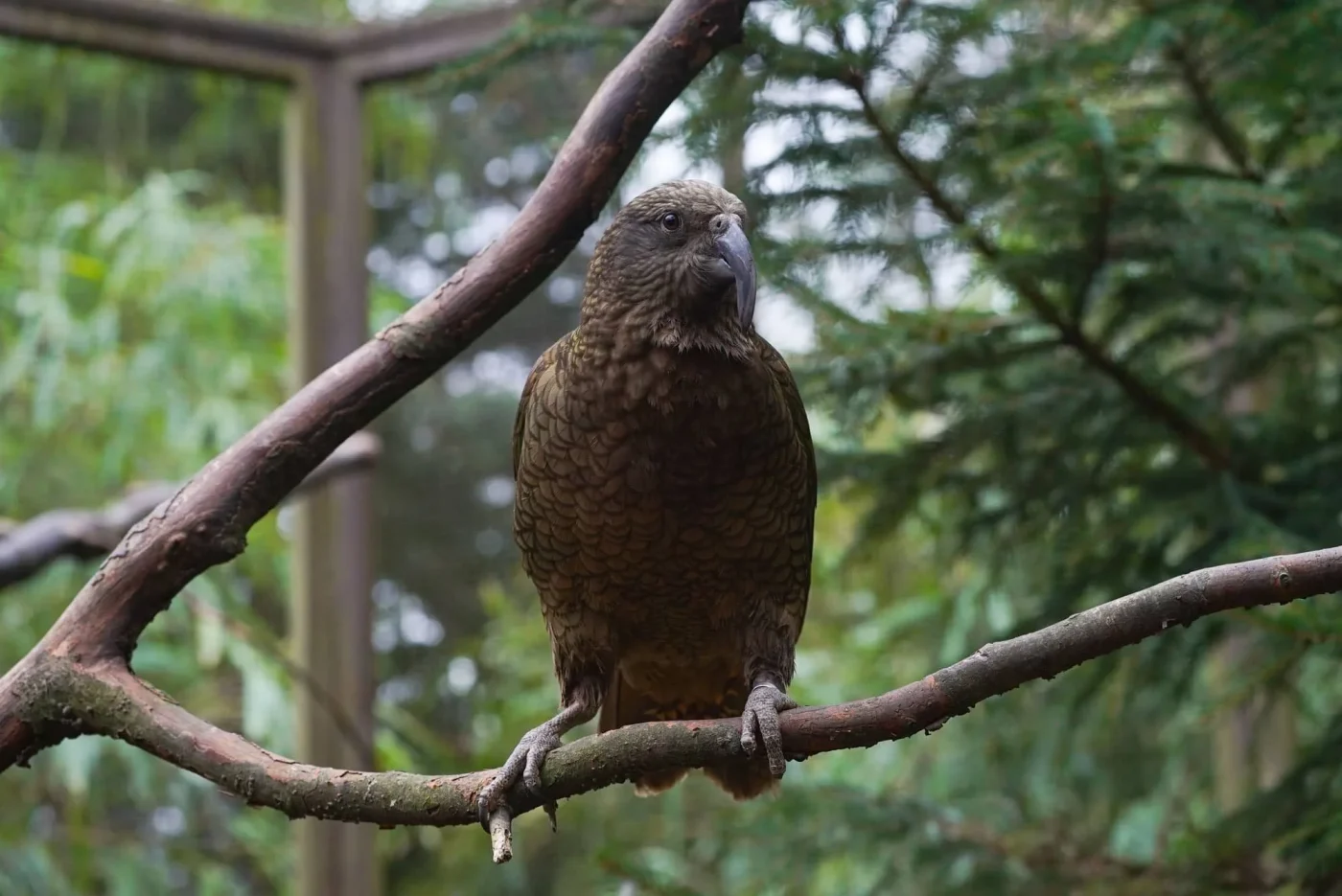
Kea parrots have an olive green color, tending towards brown, and they have orange-red flight feathers and rump. These colors are only visible when the Kea takes flight. It is a parrot with a very distinctive beak, almost unique of its kind. The Kea’s beak has an especially elongated upper mandible, which allows it to find food more easily in the harsh mountains where it lives. There is no sexual dimorphism between male and female, but juveniles can be recognized by their yellow-colored lower mandible.

Weight

922g

Habitat

Mountains and mountain forests

Diet

Opportunistic omnivore

Gestation

30 days

Longevity

14 to 15 years in captivity

Longevity

12-17 years

Location

New Zealand
Frequently Asked Questions

Where does the kea live?

The kea is a parrot family bird endemic to the mountainous regions of New Zealand. It is found mainly in mountain forests and migrates depending on the temperatures encountered, to higher or lower altitudes according to the seasons. It is found near mountain peaks when temperatures are milder, and as winter approaches, it does not hesitate to move to lower lands to find food more easily.

Behavior

Keas are social birds living in groups that can reach 30 to 40 individuals. They display numerous behaviors, including dominance and submission. The hierarchy within a group is not linear. This means that one individual may be dominant over a second individual, who is in turn dominant over a third individual, who will then be dominant over the first individual. They are very alert birds, who learn by imitating others. This behavior is due to the fact that, living in a harsh environment, they must constantly adapt in order to survive. They do not hesitate to approach humans, and are known for having fun tearing off car windshield wipers or knocking over ski resort trash cans. They communicate with each other through various vocalizations, and their name “kea” comes from a call they make while flying. In captivity, they are known to solve complex problems or even mazes. They are very curious birds, and are important for tourism because they attract crowds with their playful behavior. They are even nicknamed “the clowns of the Southern Alps” by the Department of Conservation.

They mainly live on the ground, and spend their time searching the ground and looking for food.

What does it eat?

Regarding food, kea mainly eat berries, leaves, flowers, and fruits from various native plants, but they also eat insects, bark, or nectar, depending on the seasons and available food. Occasionally, kea may eat meat, especially from the carcasses of sheep that have unfortunately fallen from cliffs or from injured animals. This harms its reputation because for many New Zealand farmers, the kea is considered a sheep predator, although it actually isn’t. Thanks to its special beak, the kea can peel away rotten tree trunks or dig the ground in search of tubers, roots, or insects.

Reproduction strategy

The pair is not faithful, and the female decides the moment of mating. The males establish a hierarchy among themselves, and only 10% of the males can reproduce. The male and female make their nest in a cliff crevice, an abandoned burrow, or on the ground between two rocks. The female incubates 2 to 4 eggs for about 21 to 30 days. The young are fed at the nest for 13 weeks, then stay with their parents for another 6 weeks before becoming completely independent. They stay together as juveniles for 1 to 3 years, until reaching sexual maturity. The reproduction of the kea takes place only once per year, usually from January to July, but can occur at any time of the year.

Conservation

Kea are threatened in their natural environment, particularly due to predators introduced to its island by settlers, who brought with them on their boats cats, dogs, and even stoats, which were originally there to eliminate rats. These animals, once they returned to the wild, attack adult kea as well as broods, since the kea is a bird that nests in ground cavities. It is estimated that 60% of nests are attacked by stoats every year. They have also been the victims of an extermination campaign following rumors claiming that kea were sheep killers. Finally, they are also regularly victims of lead poisoning, by ingesting human objects, or from poisoning by rodenticides, which are spread to eliminate rodents. These threats still weigh today on a large number of endemic species of New Zealand, such as the Nestor kaka, the kea’s cousin, or the Kakapo, an extremely rare parrot that now survives only on a few monitored islands.

Discover other species from Oceania: emu, Bennett’s wallaby, sugar glider.

Other animals to discover