Falco peregrinus

Peregrine falcon

Order: Falconiformes / Family: Falconidae / Genus: Falco

What is a peregrine falcon?

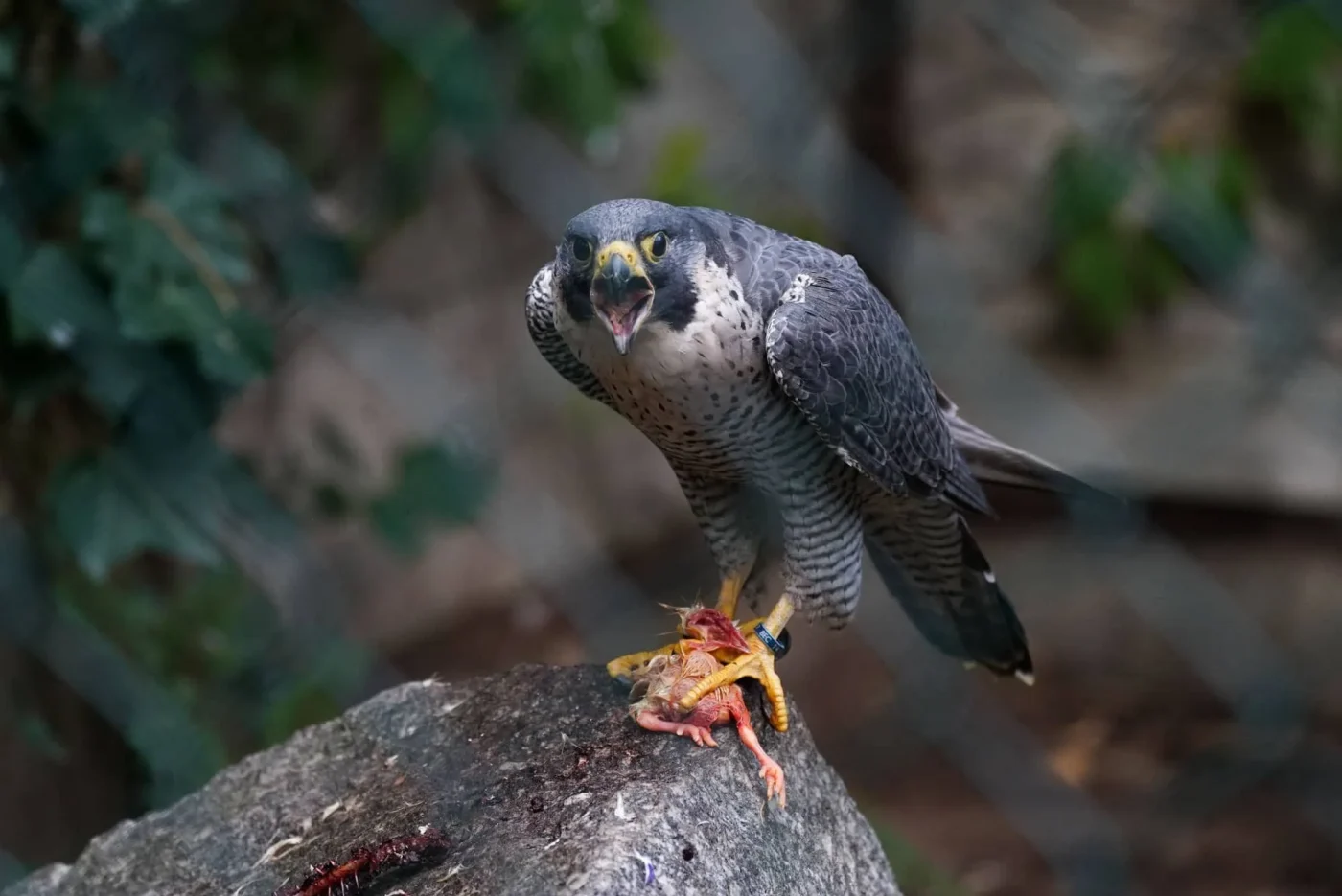
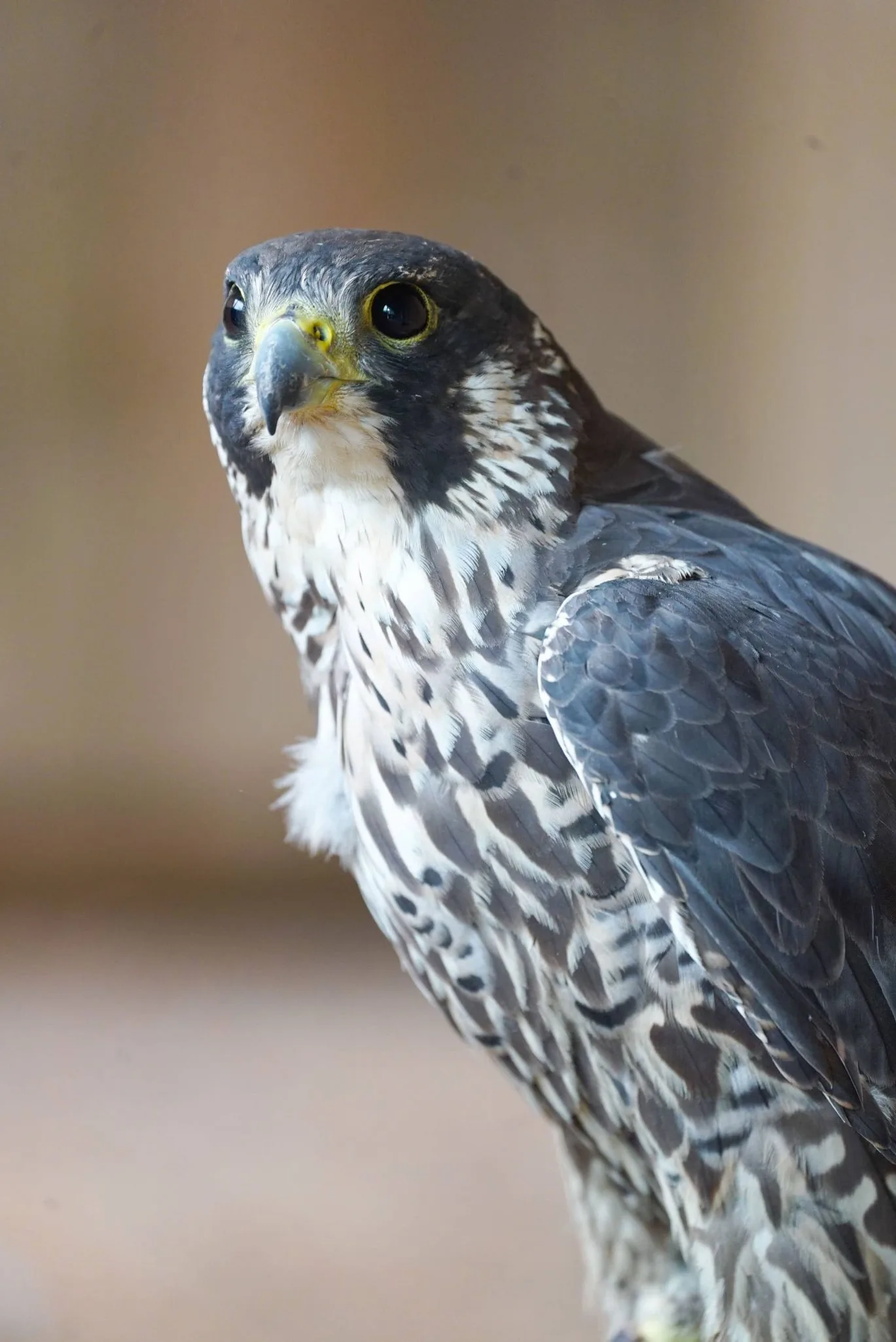
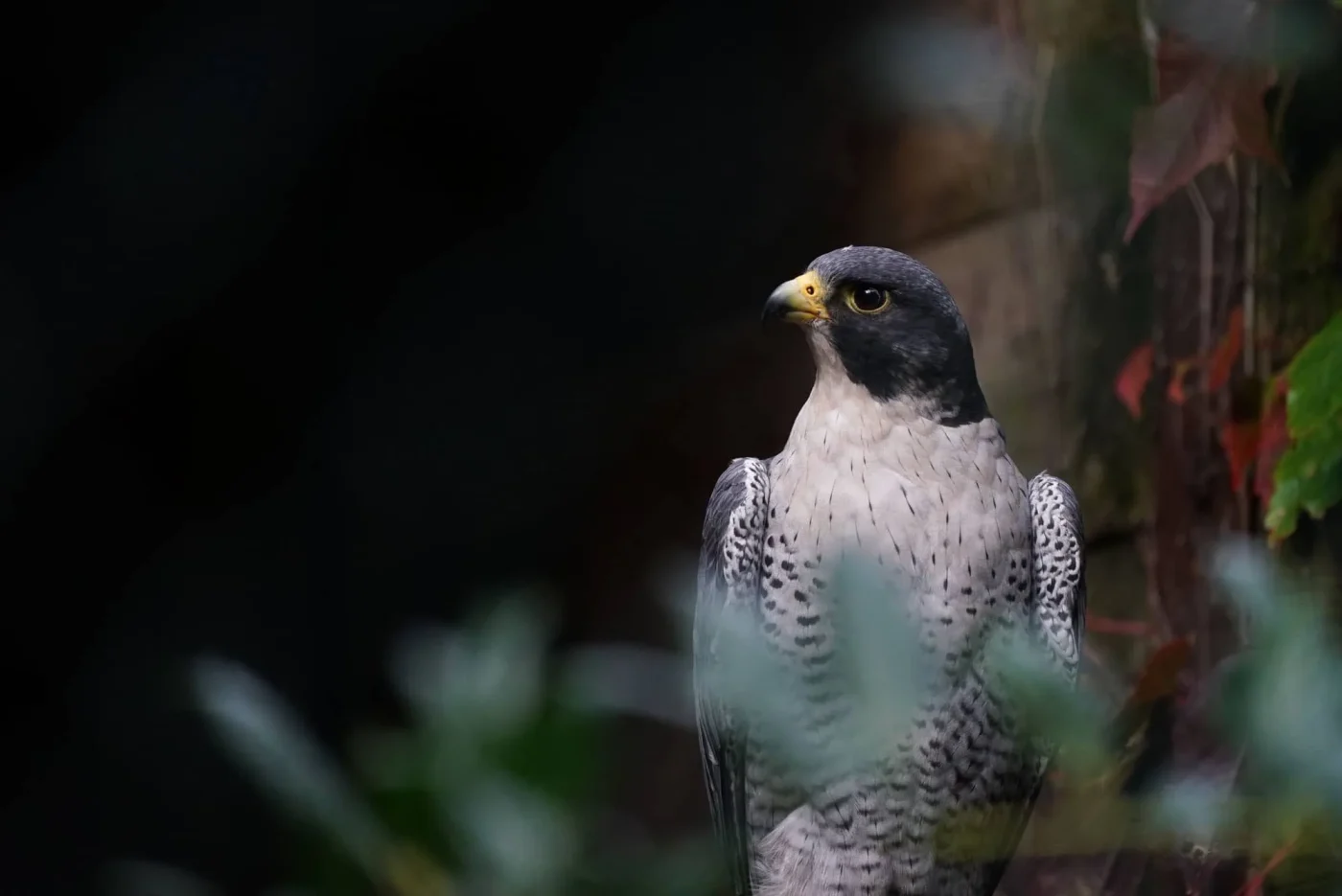
The peregrine falcon has a round black head and also black cheeks called mustaches. This particular coloration gives the impression that it is wearing a helmet. The yellow beak is short and hooked. As with all falcons, the upper mandible has a notch which would make it easier to kill prey by severing the spinal cord. The legs and the area around the eye are also yellow. There is sexual dimorphism in peregrine falcons: the female has dark gray plumage, while the male is lighter with bluish highlights. The male has a uniformly white throat, whereas the female’s is spotted with black. Additionally, the male is a third smaller than the female, hence its name ‘tiercelet’ in falconry. Nowadays, this term is used for all male birds of prey, but originally it was reserved for falcons. Young birds differ from adults by having brown or reddish plumage of varying lightness. It is a bird that stands out for its prowess in flight during reproduction or hunting.

Weight

800-1300 g (females); 600-800 g (males)

Habitat

Forest, grassland, mountainous area, desert, savanna, coastal

Diet

Carnivore

Gestation

30-35 days

Longevity

15-20 years

Longevity

12-17 years

Location

All continents except Antarctica.
Frequently Asked Questions

Where does it live?

The peregrine falcon is a bird found on every continent except Antarctica. It inhabits all types of environments except cold or hot deserts and tropical forests. It is a bird that favors rocky cliffs but it can also be observed in plains and even in urban areas. In France, it inhabits the cliffs of the Alps and the coasts of the English Channel as well as river plains. Some populations undertake migrations of several thousand kilometers, for example, populations from Canada migrate all the way to Argentina. There are 19 different subspecies of peregrine falcons, varying in size, weight, habitats, and wintering grounds.

What does it eat?

The peregrine falcon is a carnivorous bird of prey that hunts almost exclusively for prey in flight and rarely for prey on the ground or on a branch.

The success rate of these attacks varies by region and season from about 1 catch for 5 to 15 attacks. Once it has spotted prey and positioned itself in flight, the peregrine falcon tucks its wings against its body and dives at its prey at an angle between 30 and 50°. Most of the time the dive does not allow it to exceed 250 km/h. However, sometimes the peregrine falcon performs dives of more than 1 km in length, allowing it to reach speeds of 350 km/h. Once behind the prey, it quickly changes pitch in order to attack at the base of the tail. The falcon then has two choices. It can bind the prey, that is, grab it with its talons. The second option is to buffet the prey, that is, to strike it violently with its talons extended forward. In any case, because of its flight speed, the prey sometimes dies as a result of the impact with the talons. Otherwise, the falcon kills it with its beak by squeezing at the neck. Depending on the prey, it may be consumed in flight or on the ground. If the peregrine falcon is satiated, it may also hide the remains.

Ornithophagous, the peregrine falcon mainly hunts birds about the size of a blackbird. It can also eat bats, and occasionally rodents and insects. The female, being larger, is able to capture bigger prey than the male, such as wood pigeons.

Peregrine falcons play an important role in regulating the populations of their prey, such as pigeons, doves, and ducks.

Behavior

Peregrine falcons are diurnal birds. Outside of breeding periods, they are solitary birds that defend a territory. The size of the territory depends on the availability of food resources.

The peregrine falcon is renowned for its incredible agility in flight, but it does not fly very high in the sky. In fact, it is capable of exceeding 350 km/h during astonishing dives.

Flapping flight is characterized by wings bent backwards. The wingbeats are rapid, between 5 and 6 per second but with a small amplitude. On the other hand, during attacks, the amplitude and number of wingbeats increase. Flapping flights can be interspersed with gliding. Being cautious by nature, the peregrine falcon spends its nights in large conifers or, if necessary, at the top of a rock.

What are its predators?

Thanks to its abilities, the peregrine falcon is near the top of the food chain. But it is not the only bird of prey that feeds on birds. Other species, such as the great horned owl or the golden eagle, which are larger than it, can also hunt it.

Reproduction strategy

The courtship displays are aerial ballets alternating between dives, loops, and chases. The male defends his territory against intruders year after year. The females are not particularly attached to it and can change sites, and therefore males, every year. Moreover, it is the females who defend the nest from potential predators. Like nocturnal raptors, the peregrine falcon does not build a nest; it lays its eggs directly on the ground, simply scraping a hole on a cliff or using another species’ nest. The 2 to 5 eggs, reddish-brown in color, are incubated for 30 days alternately by the male and the female. In some cases, it has been observed that another immature female joins in incubation and rearing of the young. Only 40% of the young live beyond their first year.

In their natural environment, they can live more than ten years and even almost 20 years in captivity.

What threatens it?

In the 1960s, the massive use of pesticides led to a significant decline in the global peregrine falcon population. Ingested through prey, this resulted in thinner eggshells, leading to low survival rates among the young and thus a decrease in the overall population. For about 40 years, their numbers have been considered stable. However, other threats persist, such as the invasion of nesting sites by tourist activities.

Discover other animals: red panda, brown bear, Amur leopard, snow leopard, Siberian tiger, orangutan, golden eagle, caracal, binturong, white tiger, siamang, bearded vulture, sugar glider, Asian small-clawed otter, steppe eagle, leopard gecko.

Other animals to discover