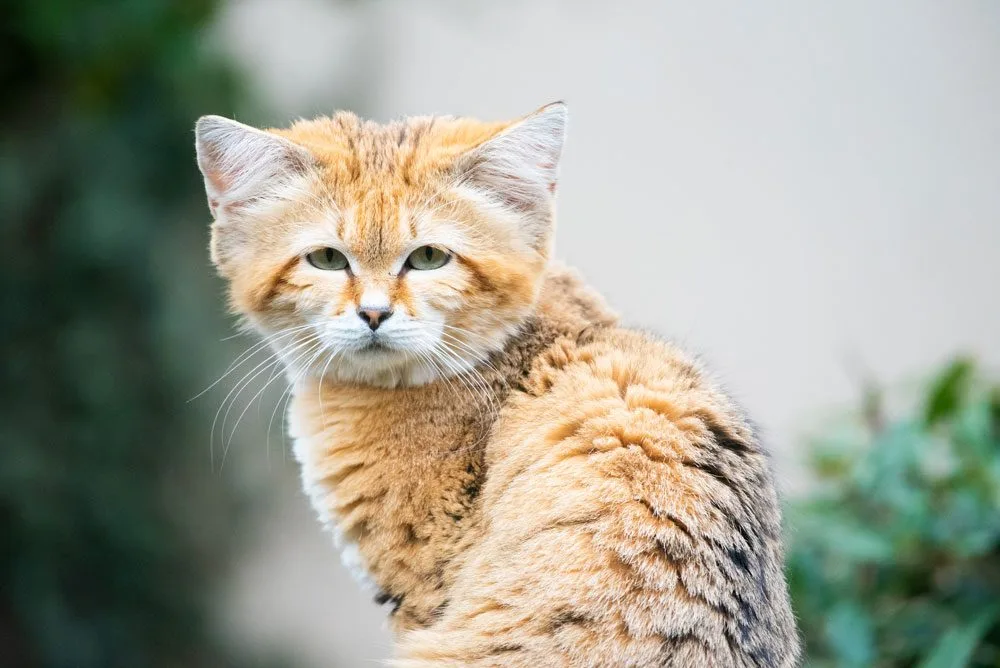
Felis margarita

Sand cat

Order: Carnivora / Family: Felidae / Genus: Felis

What is a sand cat?

It is one of the smallest species of felines in the world. A nocturnal hunter, it has large triangular ears and highly developed hearing to help it track down prey in the dark. Its ears also allow it to quickly dissipate heat.

At night, its fur protects it from the cold, and during the day, it has black, stiff hairs on the pads of its feet that help protect against potential burns from hot sands. It weighs between 1.5 and 3.5 kg. Its fur ranges from yellow-brown to gray with black stripes on its legs. It is therefore perfectly capable of camouflaging itself in the desert environment where it lives. Its body measures between 47 and 59 cm with a tail ranging from 27 to 35 cm. Its small paws give it a low profile, which is practical in an environment with little vegetation.

There are many subspecies that are quite geographically distant from one another. Populations in the West are larger than those in the East.

Its closest cousin is the wildcat (Felis silvestris), which is why it resembles domestic cats.

Weight

1.5-3.4 kg

Habitat

Desert

Diet

Carnivore

Gestation

56-66 days

Longevity

10-13 years

Longevity

12-17 years

Location

Algeria, Egypt, Iran, Iraq, Jordan, Kazakhstan, Kuwait, Mali, Mauritania, Niger, Oman, Saudi Arabia, Sudan, Syria, Chad, Turkmenistan, United Arab Emirates, Uzbekistan, Western Sahara, Israel, Pakistan, Yemen.
Frequently Asked Questions

Where does the sand cat live?

The sand cat, desert cat or also called Margueritte’s cat, was only discovered in 1858. It lives in the Sahara desert in Morocco, Algeria and Niger as well as in the Arabian Peninsula. It is also found in Central Asia from Iran to Kazakhstan.

It prefers rocky and sandy deserts as well as sparse vegetation, so it is called a psammophilous species. They are able to withstand extreme conditions since it is not unusual for temperatures to rise to 51°C during the day and drop to -0.5°C at night.

Reproduction strategy

Sand cats are polyestrous, meaning that mating triggers ovulation in the female, and the process can then be repeated with other males. They are solitary animals and only come together for reproduction. The breeding period depends on the climate and food resources: Sahara Desert populations breed from January to April, while those in Central Asia breed from April to October. After 59 to 63 days of gestation, the female gives birth to 1 to 8 kittens, with an average of 4-5. The kittens are born blind, tiny, and weigh about 70 grams. They open their eyes after about 2 weeks. The young become independent between 6 and 8 months, and sexually mature at 3 years old.

Despite a high mortality rate among the young, sand cats can live up to 13 years.

What does it eat?

Sand cats are carnivorous and hunt a wide range of prey. The desert provides very little water, so it makes do with the water contained in the prey it eats, such as spiders, birds, reptiles, or small mammals. Considered a very good snake hunter, it even attacks venomous vipers.

Behavior

Sand cats are solitary and nocturnal. Particularly rare, the sand cat is a species that is difficult to observe, so the population size of wild populations is difficult to determine. The first images of sand cats in the wild were only captured in 2017, including several kittens! It is still a relatively unknown species. Its precise range is not yet exactly known. The sand cat is not a good climber but is an excellent digger. It uses its digging skills to keep cool and escape the intense heat. The dug-out burrows are used by several cats but never at the same time.

What are its predators?

The sand cat has several predators such as the fox, raptors, caracal, or even the jackal. To protect itself, it can take refuge in its burrow.

What is it threatened by?

Suffering from a “cute” animal image, the sand cat was a victim of illegal trafficking in the early 1960s. At that time, the needs of the animals were not met and many felines died. Today, the main threat is desertification which reduces the prey available to sand cats. The introduction of domestic species such as dogs or cats creates problems of competition and disease transmission.

The sand cat is not endangered, however, it is difficult to assess its populations and various threats still weigh on the species. The reasons include the destruction of its habitat by humans as well as the introduction of domestic cats and dogs. As sources of diseases, they also compete with the sand cat, which experiences a decrease in its prey. However, this small feline seems better adapted to human activities than other species.

Discover other species from the African continent: rhinoceros, serpent eagle, African wild dog, lion, hippopotamus, gorilla, giraffe, African elephant, cheetah, caracal, meerkat, zebra, ring-tailed lemur, serval, golden eagle, white lion, gelada, ostrich, Nile crocodile, Carpathian lynx, black panther.

Other animals to discover