Python regius

Ball python

Order: Squamata / Family: Boidae / Genus: Python

Description

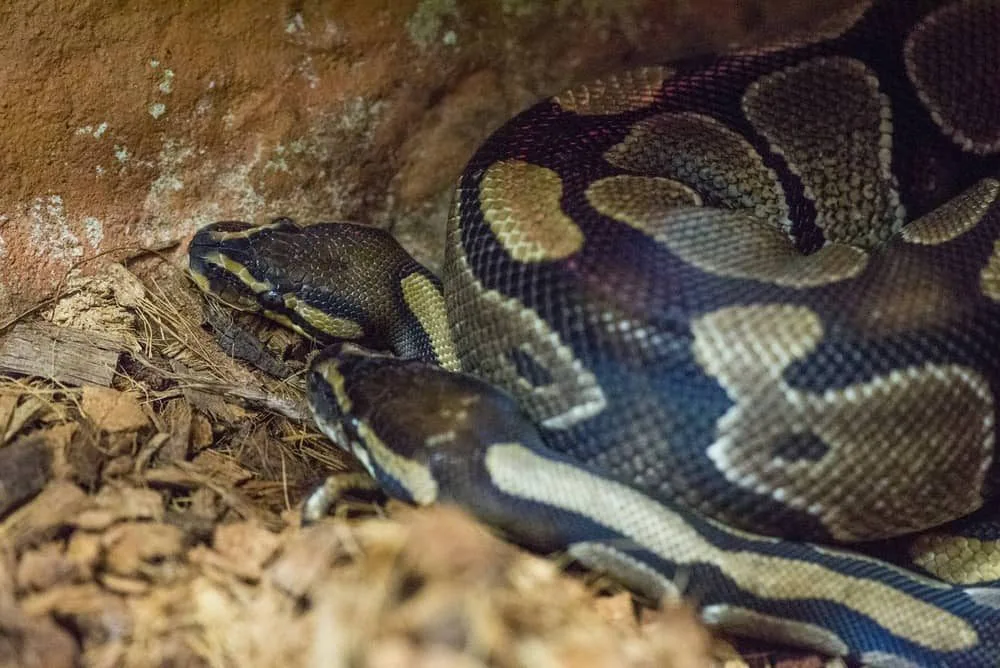
Despite its name, as an adult this python only measures between 1 and 1.5 meters. It is easily identifiable thanks to its markings alternating between cream and brown patches. The top of its triangular head is black, and a yellow stripe is often found just below, extending from the nostrils to the neck. The scales on the belly are ivory white. In adulthood, females are the largest.

Weight

3 kg

Habitat

Forests, prairies and farmlands

Diet

Carnivore

Gestation

80 to 120 days

Longevity

30 years

Longevity

12-17 years

Location

Northwest and central Sub-Saharan Africa
Frequently Asked Questions

Habitat

Ball pythons are snakes native to the grasslands, savannas, and open forests of northwestern and central sub-Saharan Africa. They easily adapt to different climates, whether dry or humid.

How long does the ball python live?

Their life expectancy is about 10 years for an individual in natural conditions and up to 20 years in captivity, with longevity records exceeding 40 years.

What does it eat?

Carnivorous like all snakes, the royal python relies on olfactory and visual signals to detect its prey. Instead of hunting actively, it sets ambushes to catch them. Its strategy is to wait, and when prey is within reach, it retracts its head and neck to strike quickly. The royal python does not produce venom, it is a constrictor: once the prey is caught, it coils around the animal and squeezes to block the victim’s blood circulation until brain function stops or cardiac arrest occurs. The royal python can then swallow its prey whole even if it is bigger than itself. As with all snakes, the lower and upper jaw are not fused and can detach from each other. The royal python mainly hunts rodents and birds. They are therefore very useful in regulating the many rodent species that proliferate, especially around human dwellings, such as the Gambian giant rat, the black rat, and the striped mouse. The extent of this advantage is estimated at millions of dollars per year.

Way of life

The royal python has another common name, the ball python; this name comes from its defense strategy: when threatened, it curls up into a ball, hiding its head within its coils. Only juveniles bite to defend themselves. An adult may eventually take up a defensive S-shaped position and hiss, but it only bites in very rare cases. This behavioral trait makes it easy to handle, which is why it is now a common and appreciated pet (exotic pet). It is a snake that mostly lives and moves on the ground, although it is capable of climbing with ease; males have a semi-arboreal tendency, which leads them to catch birds more often compared to females who will catch more mammals. Mainly nocturnal by nature, it is often observed in cultivated lands where it can find its prey.

Reproduction strategy

The ball python is oviparous; it reproduces mainly during the rainy season, from mid-September to mid-November. The female lays between 5 and 11 eggs during the dry season, then incubates the eggs for about 2 months. The female coils around her eggs to protect them. The eggs are usually stuck to each other and separate as hatching approaches. The young emerge on their own by breaking the shell. At birth, the juveniles measure 25 to 45 cm and weigh 65 to 100 g. From then on, the female leaves the young to fend for themselves. Sexual maturity for females is reached between 27 and 31 months, and for males between 16 and 18 months. Telling the sex of an individual is almost impossible to the naked eye; it is necessary to use a probe to discover this: by placing it in the animal’s cloaca, one can determine the sex based on the depth reached without forcing: it will go deeper in males (about 9 subcaudal scales) than in females (1 to 3 subcaudal scales).

What are its predators?

Sightings of predation on adult ball pythons are rare. Carnivorous mammals, birds of prey, or other species of snakes that consume this snake are more likely to attack young or smaller pythons.

What threatens it?

His gentle and calm nature makes him a very appreciated reptile among exotic pet enthusiasts. With the increasing popularity of the ball python among individuals, many variations in color and pattern have appeared. But be careful about the origin of the animals: some intensive breeding operations produce snakes that are stressed, fragile, and have a shorter lifespan. Currently, the ball python is considered near-threatened on the Red List of Threatened Species, yet every year about 30,000 to 50,000 wild ball pythons are taken to supply the American trade. The species is also poached for its meat and skin as well as for local customs and practices.

Discover other species from the African continent: rhinoceros, serpent eagle, African wild dog, lion, hippopotamus, gorilla, giraffe, African elephant, cheetah, caracal, meerkat, zebra, ring-tailed lemur, serval, golden eagle, white lion, gelada, ostrich, sand cat, dik-dik, flamingo, fennec fox, banded mongoose, steppe eagle, grey-crowned crane, red river hog, spotted hyena, Nile crocodile, rock hyrax.


Other animals to discover