Potamochoerus porcus

Red river hog

Order: Cetartiodactyla / Family: Suidae / Genus: Potamochoerus

HABITAT

The red river hog is a species found in West Africa and central sub-Saharan Africa, specifically from Guinea to the Democratic Republic of the Congo. It inhabits various environments such as primary and secondary forests, swamps, as well as steppes. Some red river hogs are also found on the island of Madagascar, and two possible explanations exist for this. The first hypothesis is that it was imported to the island by humans. The second hypothesis is that they arrived on the island by drifting on beds of papyrus, which can sometimes break off and float very well.

There is a second species, the Cape bush pig, which is found in the southern and eastern parts of the African continent.

Weight

50-130 kg

Habitat

Forest

Diet

Omnivore

Gestation

120-127 days

Longevity

15-20 years

Longevity

12-17 years

Location

West and Sub-Saharan Africa
Frequently Asked Questions

Description

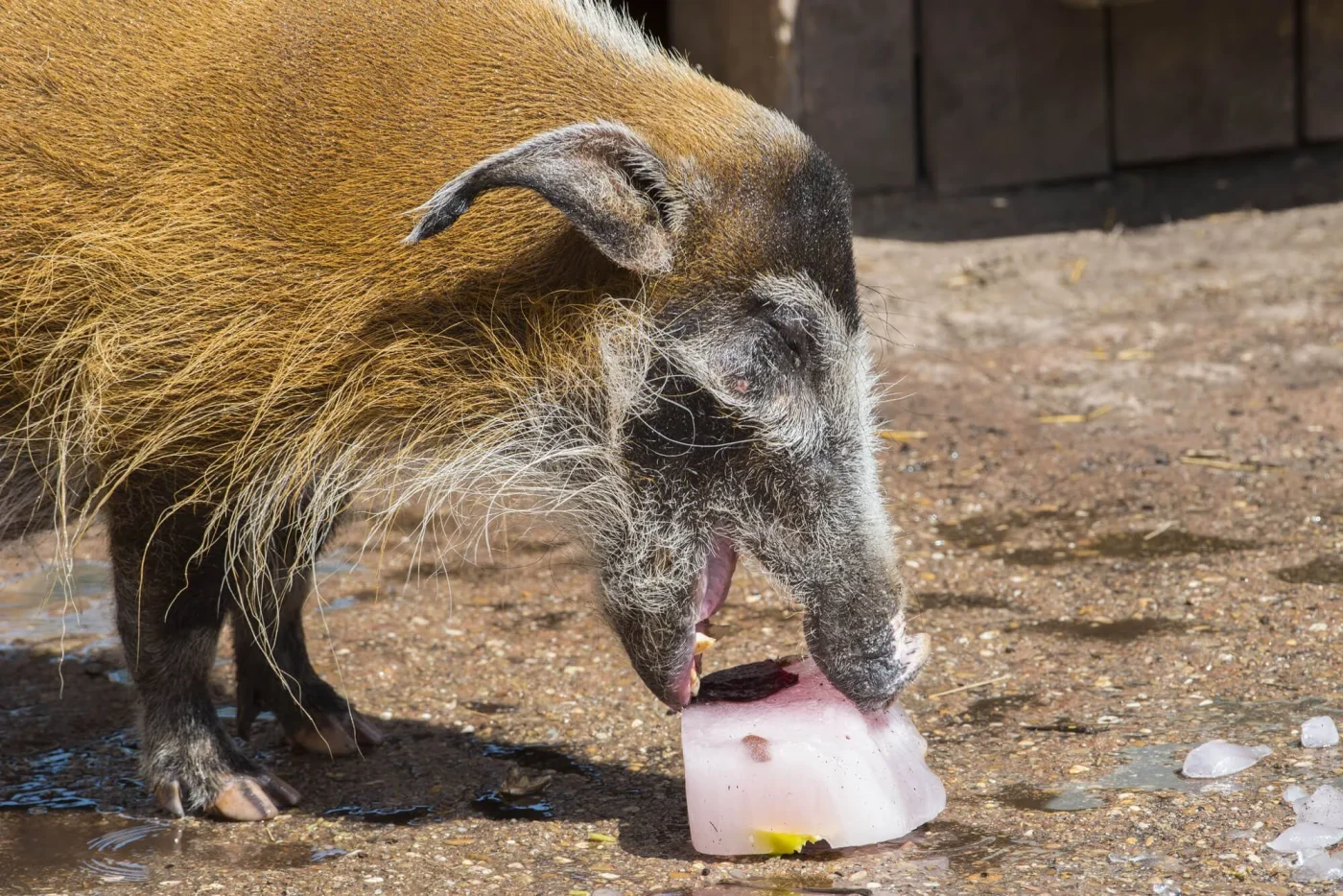
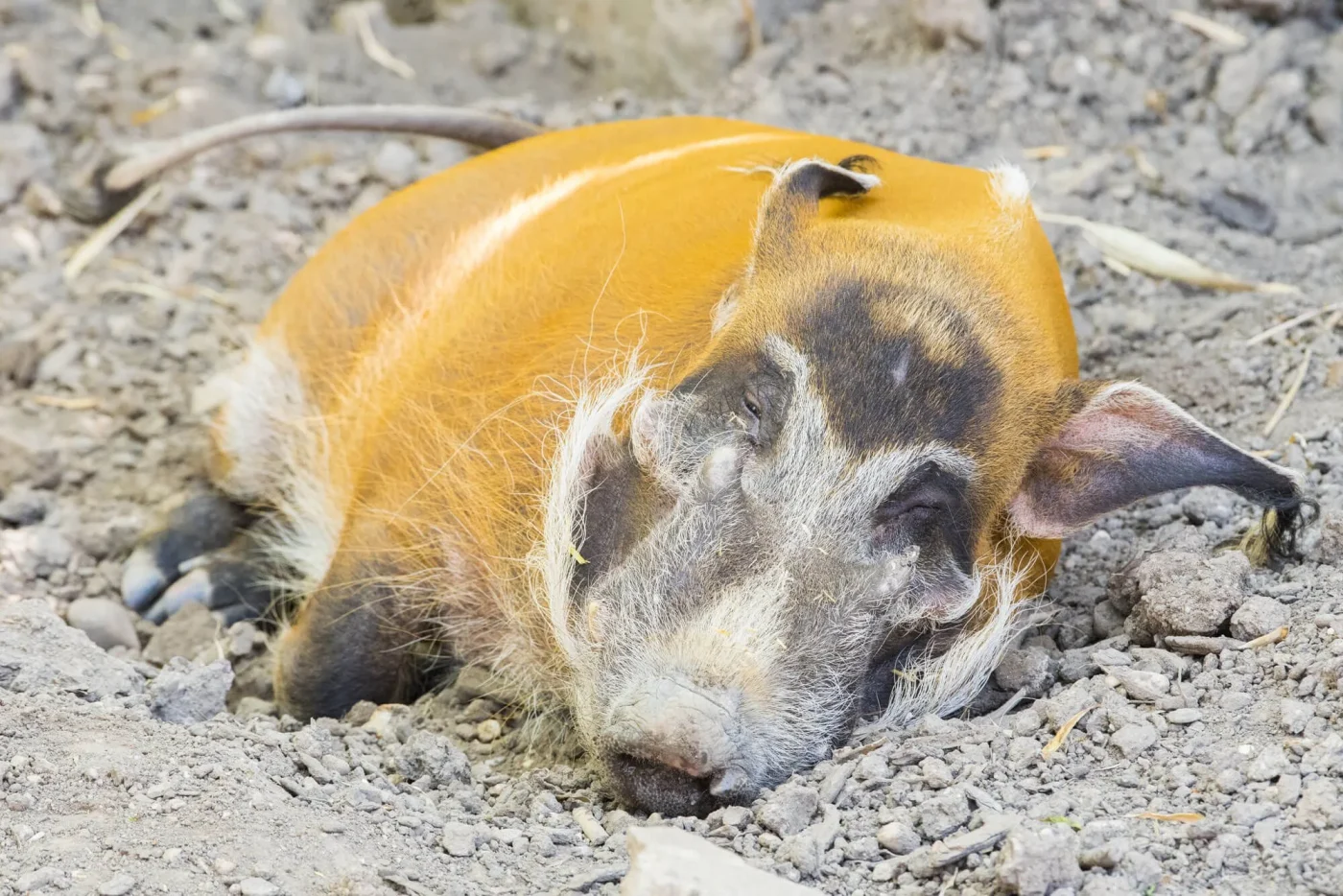
There are 2 species of bushpig, the red river hog and the Cape bushpig, themselves divided into 13 subspecies. The two species are distinguished by the color of their coat. The red river hog has a reddish coat with a white stripe along the back. The Cape bushpig has a more brown coat that can appear almost black. Generally, the bushpig has a white facial mask. The bushpig is easily distinguished from other members of the suid family, notably by the white tufts at the tips of its ears. It measures between 1 and 1.5 meters in length and stands 50 to 90 cm at the shoulder. Males and females have long canines, called tusks, which can measure 7 cm on the upper jaw and 19 cm on the lower jaw.

Behavior

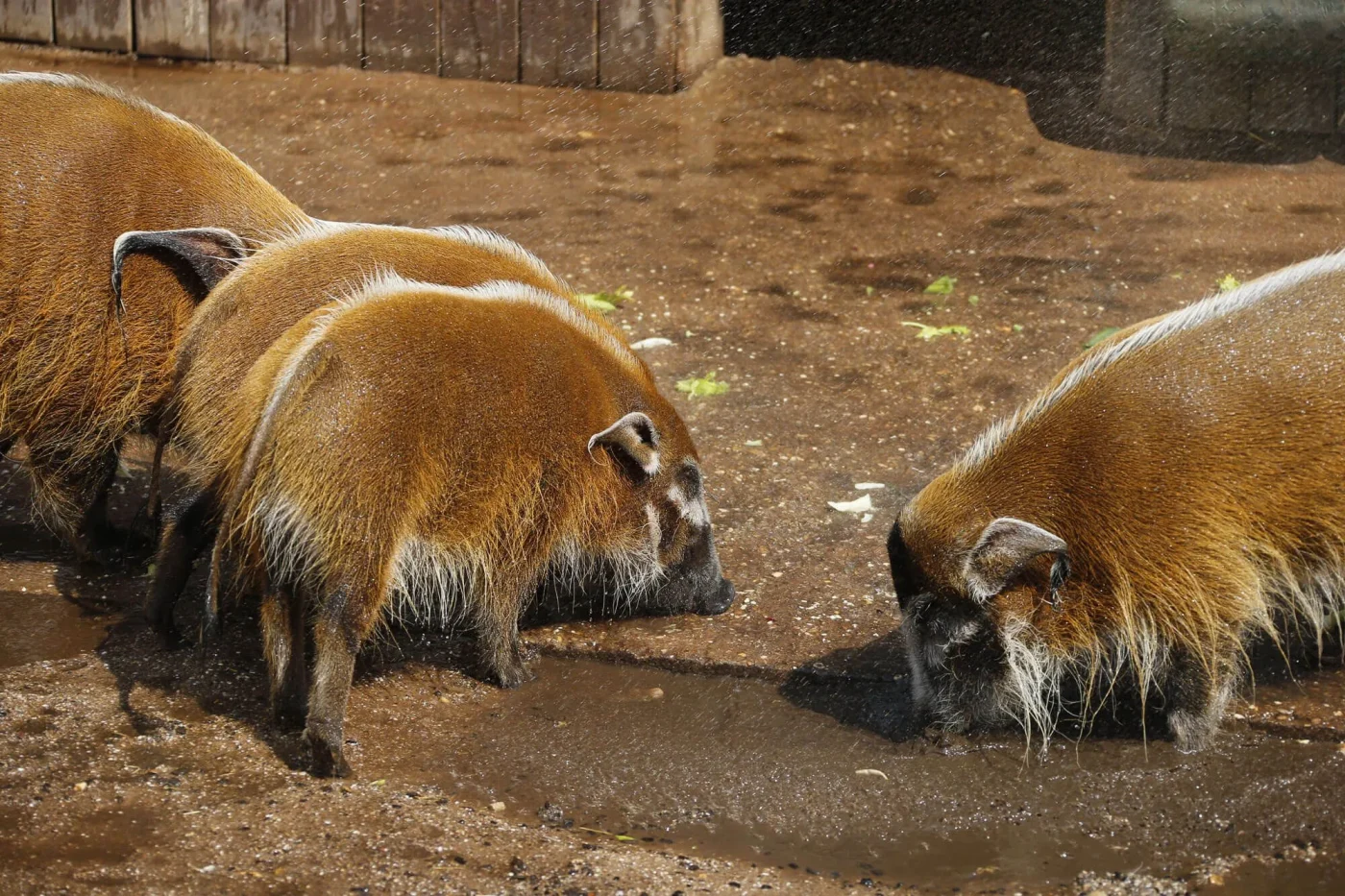
Red river hogs are social animals that live in groups of about ten individuals. Within this group is a dominant male, as well as females and young. These small groups can merge and form groups of around one hundred individuals. However, some adult individuals can be solitary.

Mainly crepuscular and nocturnal, it spends its days in a burrow dug into dense vegetation. It prefers the cover of night to find food in order to protect itself from predators such as the leopard, for example. To mark their path, males mark the ground and tree trunks with their tusks as well as their pre-orbital and plantar scent glands. During confrontations, males whip each other with their tails and give head and snout butts.

The red river hog is an excellent swimmer. It’s not only talented in water, as on land it can reach a running speed of around 50 km/h.

What does the red river hog eat?

The red river hog is an omnivore and a generalist. Its diet consists of fruits, seeds, roots, aquatic plants, mushrooms, eggs, birds, reptiles, and insects.

Sometimes, some individuals may even feed on animal carcasses. It is also known for not leaving anything behind. In fact, it is often seen following a group of chimpanzees to collect the remains of forgotten or abandoned fruits. It finds its guilty pleasure—the undigested seeds of Balanites wilsoniana—in elephants’ droppings! Thanks to its oversized canines, it can also dig the ground in search of roots, bulbs, or even buried insects.

Reproduction strategy

The vast majority of bushpigs live in family groups with a monogamous pair or only the male is dominant. During the breeding season, which begins in September and ends in April, the female digs a “nest” 3 meters in diameter and one meter deep, also called a depression. Lined with grass, this nest then becomes a favorable place for giving birth. After a gestation period of about 4 months, the female gives birth to young piglets weighing between 600 and 900 grams. The litter size varies between 1 and 6 young. Each female reproduces only once per year with birth peaks between November and February, corresponding to the hot and humid season. Once the piglets are born, they remain in the nest for the first 15 days before being able to follow the rest of the group. At birth, the young have a black coat spotted and striped with creamy white. This coloring provides better camouflage in the vegetation. Only around the age of 6 months does the coat gradually become the same color as their parents’. Weaning takes place at 3 months old and they reach sexual maturity around the age of 3 years.

How long does it live?

Red river hogs have a lifespan of 15 to 20 years.

What threatens it?

Classified as Least Concern, they still face threats, notably the loss of their habitat. Indeed, deforestation to make way for crops considerably reduces the living areas of the bushpig. Hunting for meat also impacts the populations. Unfortunately, they are also killed because they are labeled as pests to crops and carriers of diseases. In fact, bushpigs carry African swine fever, which is transmitted to domestic pigs via ticks.

What are its predators?

Their main predators are carnivores such as panthers, lions, hyenas, crocodiles, and African wild dogs, but other animals can also prey on the piglets, like Seba pythons, birds of prey, or even small felines such as the serval, for example.

Discover other species from the African continent: rhinoceros, serpent eagle, African wild dog, lion, hippopotamus, gorilla, giraffe, African elephant, cheetah, caracal, meerkat, zebra, ring-tailed lemur, serval, golden eagle, white lion, gelada, ostrich, sand cat, dik-dik, flamingo, fennec fox, banded mongoose, steppe eagle, grey crowned crane.

Other animals to discover